
Hello, and welcome to The Crush Bar, a newsletter about theatre by Fergus Morgan.
This is the free Friday issue, which usually contains an interview with an exciting theatremaker or an essay on a theatre-related topic. This week, it is a bit from me responding to a popular Substack essay published recently. After that, there are your usual three show recommendations: two in London and one in Scotland.
In case you missed it, here is this week’s issue of Shouts and Murmurs, which is a weekly round-up of the most interesting writing about theatre elsewhere…

You can get Shouts and Murmurs straight in your inbox every Tuesday - and help keep this newsletter going - by signing up as a paid supporter of The Crush Bar.
Theatres, companies, agencies and other organisations can also sign-up as champion supporters of The Crush Bar, which gets their name in this dedicated tab on The Crush Bar’s Substack homepage and in the footer of every Friday issue.
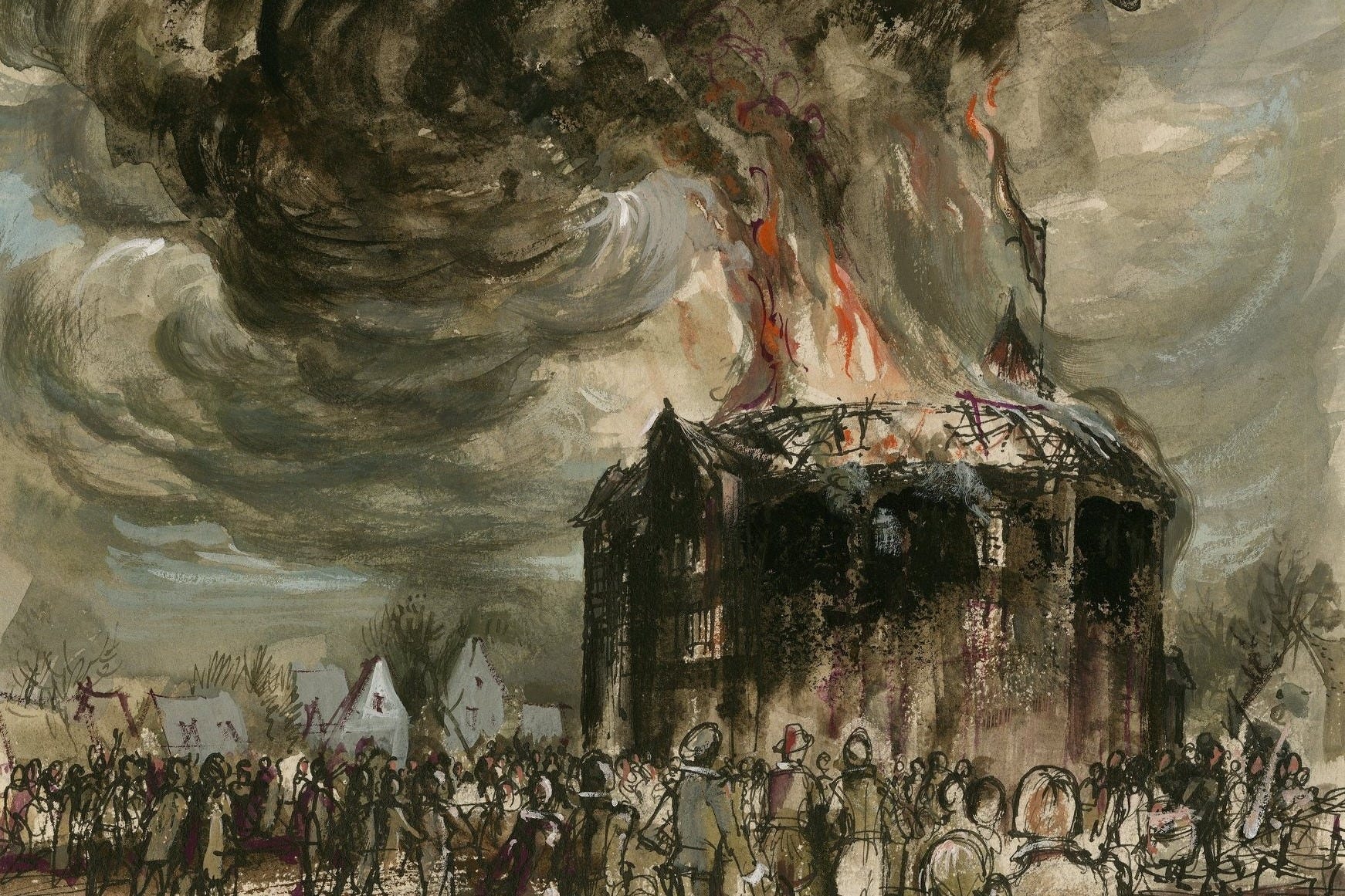
Have you read this essay by James Marriott on our “post-literate society” yet?
Quoting everyone from Eric Havelock to Neil Postman, James Marriott argues that hyper-addictive smartphones are to blame for the collapse in reading levels over the last decade, and points out some alarming consequences. Reading, he says, engenders a complexity of thought that cannot be achieved in other media. As these “literate habits of thought” decline, so does our cognitive ability. Hence scary graphs like this:
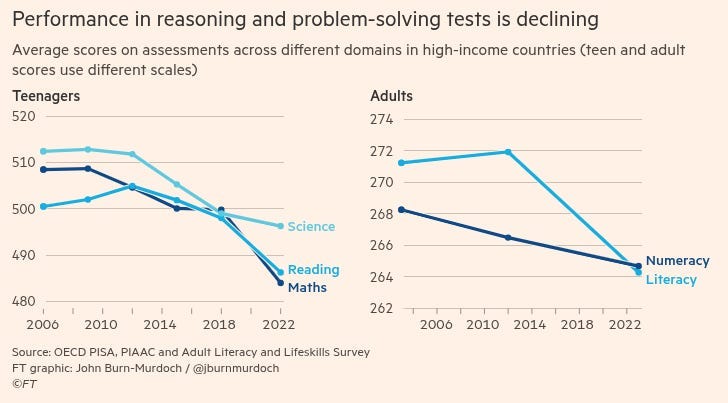
Students, minds addled by short-form video, can no longer tackle classic texts. People, unable to react rationally to the real world, turn to the easy answers and cheap tricks of populist politicians and online influencers. And - relevant to our interests - audiences, unwilling to engage with challenging art, increasingly favour the familiar.
“Pop songs in every genre are becoming shorter, simpler and more repetitive and films are being reduced to endlessly-repeated franchise formulas… Even books themselves are becoming less complex. If the literate world was characterised by complexity and innovation, the post-literate world is characterised by simplicity, ignorance and stagnation. It is probably not an accident that the decline of literacy has ushered in an obsession with cultural “nostalgia”; a desire to endlessly recycle the cultural forms of the past: the television shows and styles of the nineties, for instance, or the fashions of the early 2000s.”
If Marriott is right - and that is a big if - then where does theatre sit in this post-literate society, I wonder? Plenty of people like to think theatre is immune from the malign influence of smartphones and social media because, whereas scrolling is an isolated, screen-based activity, theatre is a communal live experience.
I am not convinced by this exceptionalism. Just because it involves an audience shutting themselves in a dark room without their smartphones does not mean that theatre exists independently of the forces shaping society’s cultural sensibilities.
Commercial theatre in particular is, to a large extent, defined by those forces. It needs bums on seats so it gives people what they want, and the people want what they know.
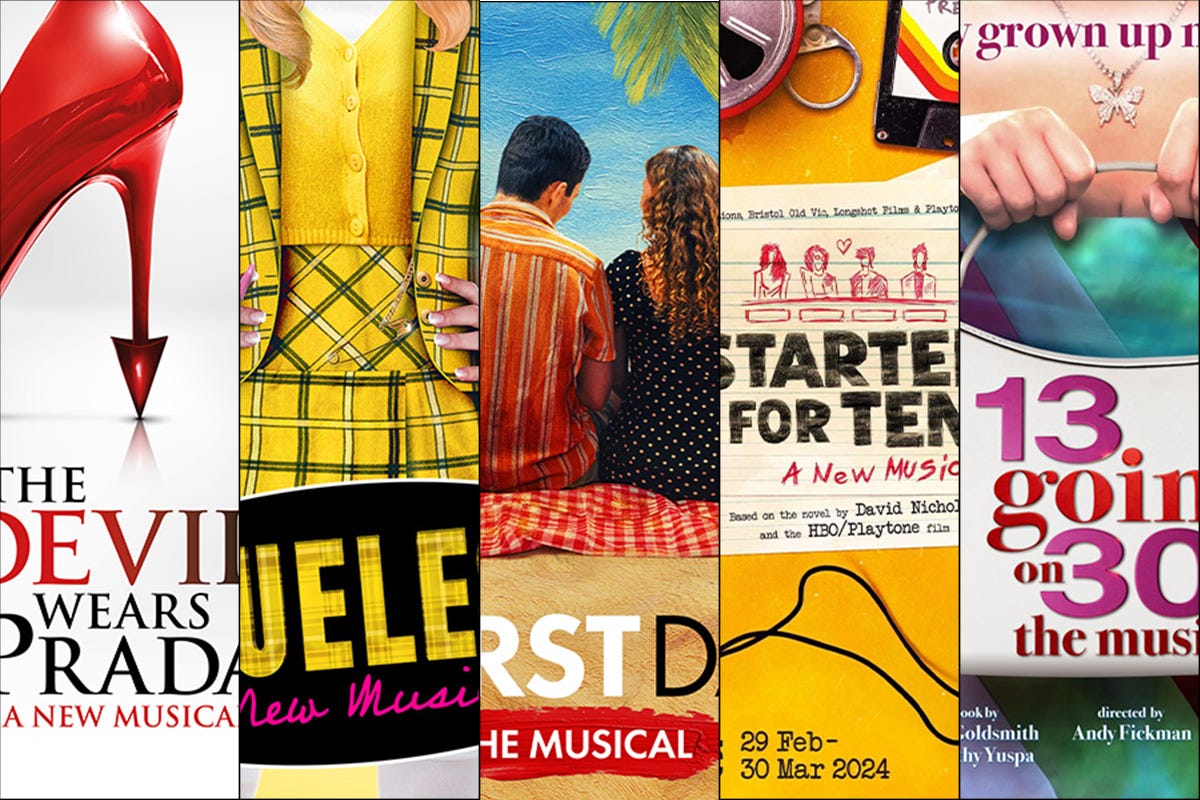
Witness the relentless treadmill of movie-to-musical adaptations: there have been two, 50 First Dates and 13 Going On 30, in the last fortnight, and a third, Starter For 10, is about to return. Witness the West End shows that have remained unchanged for decades: Les Mis, Phantom, Mamma Mia!, The Lion King. Witness the trend of popular series getting stage spin-offs: Harry Potter, Stranger Things, The Hunger Games. Witness that SOLT survey, quoted in last week’s Shouts and Murmurs, which revealed that theatregoers are “most encouraged by strong signals of quality” like “a beloved story.”
“Our culture is being transformed into a smartphone wasteland. Cut off from the cultural riches of the past we are condemned to live in a narcissistic eternal present. Deprived of the critical tools to question and develop the insights of those who went before us, we are condemned to repeat and pastiche ourselves, superhero film by superhero film, repetitive pop song by repetitive pop song.”
And, Marriott could add, uninspired movie-musical by uninspired movie-musical.
What about subsidised theatres? Isn’t public funding and the opportunities it allows for artistic risk-taking over commercially-minded audience-chasing going to save us?
Perhaps in theory, but shrinking subsidy has put huge pressure on our institutions to think commercially since 2010. Today, a musical based on a movie is just as likely to originate from a subsidised theatre as from a commercial outfit. Starter For 10 began at Bristol Old Vic. One Day will open at the Edinburgh Lyceum. This kind of crowd-pleasing is understandable, but the more it is necessary, the less room there is for theatres to programme innovative new writing and interrogate classic works. Sadly, most institutions are far too fragile to withstand the forces now shaping popular taste.
Hang on, you might say. Isn’t this argument a bit paradoxical, or elitist, or both? How can you advocate for revisiting classic literature and decry revisiting popular films in the same breath? What makes a musical version of The Devil Wears Prada bad but another reimagining of Hedda Gabler good? Aren’t you an enormous hypocrite?
Well, alright Jez, but there are adaptations and there are adaptations, aren’t there? What matters is not the title being adapted but the spirit in which it is done. You will find no hypocrisy here, only a bias towards thought. A thoughtlessly trad take on Ibsen is as bad as a thoughtless remake of a romcom. I would favour an interrogative interpretation of a popular title over a mindlessly conventional revival of a classic play. It just rarely happens that way around. The only exception I can think of is Jamie Lloyd with his hugely popular avant-garde revivals of Andrew Lloyd Webber musicals. Maybe The Curious Case Of Benjamin Button, too? I don’t know. I haven’t seen it.
Hang on again, you might add. Fine, the pressures facing the contemporary theatre industry might mean that it must think commercially; and thinking commercially might mean catering to popular taste; and popular taste might be becoming increasingly unadventurous as we are all slowly stupefied by our smartphones.
Isn’t theatre an ancient artform, though? Doesn’t it predate popular literature by millennia? And hasn’t repetition and revival been baked in from the beginning?
What are Greek tragedies if not “endlessly repeated franchise formulas”? What is our veneration of Shakespeare if not “an obsession with cultural nostalgia”? Isn’t “recycling the cultural forms of the past” what theatre has always done? Theatre existed in a pre-literate society. Why should it worry about a post-literate society?
Ah, but ancient Athens and Shakespearean England were literate societies, at least to a degree. In his piece, Marriott cites Havelock’s argument that “the arrival of literacy in ancient Greece was the catalyst for the birth of philosophy”: he also argued that it was the catalyst for the profound change in performance in the ancient world that resulted in the sophisticated tragedies of Aeschylus, Sophocles, Euripides and the comedies of Aristophanes. Similarly, Marriott cites Elizabeth Eisenstein’s point that “the invention of the printing press helped to catalyse a series of cultural revolutions which forged the modern world: the Renaissance, the Reformation, and the scientific revolution.” You can probably slot the plays of Shakespeare in there somewhere, too.
Of course, oral traditions have played a huge role in the evolution of theatre - there is an argument, outlined in my excellent podcast, that modern Scottish theatre owes much to Gaelic traditions of storytelling, for example - but it is true that most of the cherished works of European drama - from Oresteia to Hamlet to Sunday In The Park With George - would not exist without the literate societies that birthed them. There is a reason you don’t see revivals of plays from the Dark Ages: there aren’t any to revive.
And, according to Marriott, our literate society is now being dragged into the abyss by “the screen revolution”, taking politics and culture as we know them with it.
The tradition of learning is like a golden thread of knowledge running through human history linking reader to reader through time. It last snapped during the collapse of the Western Roman Empire as the barbarian tides beat against the frontier, cities shrank and libraries burned or decayed. As the world of Rome’s educated elite fell apart, many writers and works of literature passed out of human memory, either to be lost forever or to be rediscovered hundreds of years later in the Renaissance. That golden thread is breaking for the second time.

Are we really headed for a new Dark Ages or is Marriott being a bit much? Is theatre really doomed or do I just not like movie-musicals? Have we both gone a bit Principal Skinner? Do I really think any of this? Perhaps. Perhaps not. Maybe Marriott’s piece is more of a provocation. Or an advert for dumbphones. Maybe this piece is as well.
It does seem ridiculous to read the death of contemporary culture into a so-so adaptation of a noughties rom-com. Smartphones and social media are fundamentally eroding the pillars that modern society is built upon, though, and it also seems naïve to presume theatre is somehow unsusceptible to the forces that has unleashed.
The worry is not that theatre will not survive. It is that good theatre will not survive.
It is that popular theatre will be reduced to unimaginative and unchallenging reproductions that trade in familiar narratives, unsophisticated ideas and easy sentiment, and that everything else will be pushed further to the fringes, where only the weirdos, the wealthy and the heavily subsidised Europeans can appreciate it.
Can’t you see it happening in all those shows based on existing phenomena? In the shrinking space for new work? In the terrible, tribal state of our critical culture?
Can’t you feel it happening in your own mind as you scroll and scroll on Instagram or TikTok instead of reading Ways Of Seeing or whatever? Don’t you feel stupider?
It seems to me that everything great about modern theatre - the boundary-breaking plays of Tom Stoppard, Caryl Churchill, Lucy Kirkwood, and Alice Birch; the radical revivals of Rob Icke, Rebecca Frecknall and Carrie Cracknell; the innovative musicals of Stephen Sondheim - requires a reading, thinking society to survive and thrive.
But, if Marriott is right - and, once again, that is a big if - then because of smartphones and social media, we no longer read, and so we no longer think. And, in a world in which we do not read or think, what chance does that kind of theatre have?
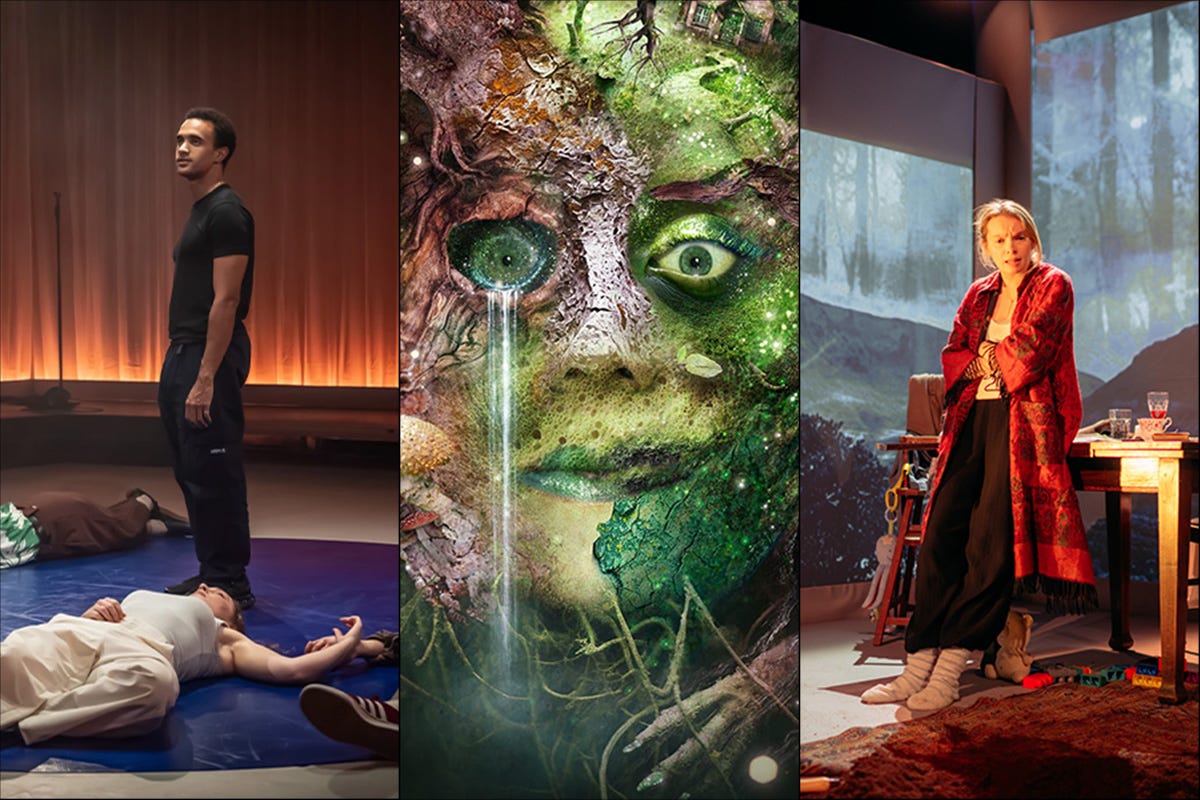
Three shows to see next week
Scenes From The Climate Era - Playground Theatre, until October 25
Australian playwright David Finnigan’s Scenes From The Climate Era offers up over 50 plays in 80 minutes, all related to the climate crisis. It was staged to acclaim in Sydney in 2023 and now makes its European premiere - produced by the Gate Theatre and directed by Atri Banerjee - at the Playground Theatre. The Stage’s Dave Fargnoli gave it four stars and called it a “bleak, yet beautifully told” survey “of the fleeting hope and existential dread of our troubled times.” You can get tickets via the button below.
Bog Witch - Soho Theatre Walthamstow, until October 25
Performance artist Bryony Kimmings became a star in the 2010s through a series of entertaining autobiographical shows, including Fake It ‘Til You Make It, A Pacifist’s Guide To The War On Cancer, and I’m A Phoenix, Bitch. Now, she is back with her new first solo show since 2018, Bog Witch, which follows Kimmings’ experience uprooting her life and moving to the countryside to become an eco-warrior. It opens at Soho Theatre’s Walthamstow venue next week. You can get tickets via the button below.
Night Waking - touring, until October 31
Sarah Moss’ 2011 novel tells the story of an Oxford academic who moves to the Hebrides with her family, then discovers the grave of a dead baby in her garden. Now, it has been adapted into a compellingly kaleidoscopic one-woman play by writer Shireen Mula and director Rebecca Atkinson-Lord, featuring a terrific performance from Nicola Jo Cully. Produced by An Tobar and Mull Theatre, it is touring Scotland all month. I saw it at the Traverse Theatre on Wednesday and loved it. You can read my four-star review in The Stage here and get tickets via the button below.
Thanks for reading and supporting The Crush Bar
Thanks to all 4880 subscribers, to all 138 paid supporters, and particularly to The Crush Bar’s champion supporters, whose contributions make all this possible.
The Royal Court Theatre, Francesca Moody Productions, Raw Material Arts, Jermyn Street Theatre; Hampstead Theatre; Storytelling PR; Premier Scotland; Ellie Keel Productions; The Women’s Prize For Playwriting
Your organisation can become a champion supporter of The Crush Bar, join that list, and help keep its independent coverage of theatre going via the button below.
That is it for this week. If you want to get in touch about anything raised in this issue - or anything at all - just reply to this newsletter. See you on Tuesday.
Fergus
Really interesting article, particularly enjoy the use of data - however, without knowing what the scale actually means it's hard to tell what that actually means!
Personally, I think more of a threat is the ubiquity of streaming and other media that means that everything is now available on your phone to watch. This creates the perception that art should be as close to free as possible. It's happened to music with Spotify and Napster, and theatre could follow.
But as the other commenter said - there has always been an existential threat to other technologies and we've been ok thus far. And, with smart marketing, places like the Bristol Old Vic etc could use these crowd pleasers as an entry point for new audiences to discover new writing. And, there has been proof that great new writing still does well with the existence of places like The Royal Court (sold out until the New Year), Brixton House's Black Power Desk, Bush Theatre and heck even adaptations of Annie Ernaux still reaching audiences in the capital comfortably.
And it's enough to say that there must be a hunger for new writing as places like Soho Theatre have just announced new writing initiatives.
I think we'll be ok.
I'm old enough to recall when cultural critics thought television would kill the thirst for challenging theater. It did not. Before that, film was supposed to kill it. It did not. Radio was sure to do it, video games and I'm sure someone cried that telephones would lead to some sort of brain rot. Theater survives because weirdos who need to create it and a combination of snobs both cultural and intellectual need it to feel superior to the masses, which isn't necessarily a bad thing.