
"It interrogates our relationship to watching horrific things online. Are we complicit?"
Playwright and actor Georgie Dettmer on her debut play Are You Watching? at the Royal Court, Carrie Cracknell's production of The Deep Blue Sea, and more. Plus: three shows to see next week.
Hello, and welcome to The Crush Bar, a newsletter about theatre by Fergus Morgan.
This is the free Friday issue, which usually contains an interview with a theatremaker or an essay on a theatre-related topic. This week, it is a chat with playwright and actor Georgie Dettmer, whose debut play Are You Watching? opens Upstairs at the Royal Court next week. After that, there are your usual three show recommendations.
In case you missed it, here is this week’s issue of Shouts and Murmurs, which is a weekly round-up of the most interesting writing about theatre elsewhere…

You can get Shouts and Murmurs straight in your inbox every Tuesday - and help keep this newsletter going! - by signing up as a paid supporter of The Crush Bar.
Theatres, companies, agencies and other organisations can also sign-up as champion supporters of The Crush Bar, which gets their name in this dedicated tab on The Crush Bar’s Substack homepage and in the footer of every Friday issue, plus full access to The Crush Bar and Shouts and Murmurs for ten different emails.
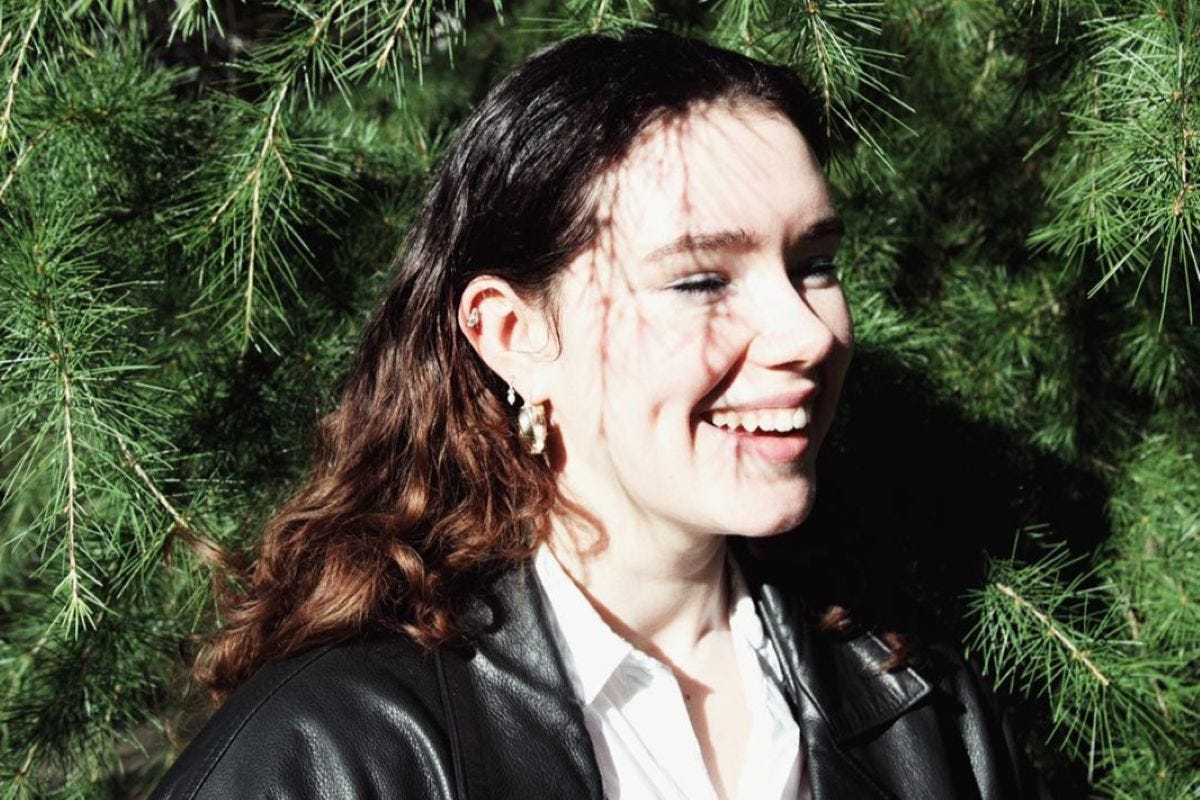
Caryl Churchill. Sarah Kane. Anya Reiss. The list of playwrights who made their debuts Upstairs at the Royal Court is an illustrious one.
Next week, a new name will be added to that list, when Georgie Dettmer’s play Are You Watching? opens in the Sloane Square theatre’s famous studio space. Directed by Jess Edwards and starring Lucy McCormick, Nicholas Rowe, Maimuna Memon and more, Dettmer’s debut deals with the ways in which smartphones and social media are warping our relationship to sex, war, and the world around us. “As the lines blur between entertainment and abuse, technology and sex, violence and voyeurism, who is complicit and who is in control?” asks the show’s blurb. “And are you watching?”
Born in 2000 (I know) and raised in Hertfordshire, Dettmer fell in love with theatre after seeing Willie Russell’s Blood Brothers as a teenager, then threw herself into student drama at Oxford University, before training as an actor at the Royal Central School of Speech and Drama, graduating in 2024. Her play Attempts On A Birch Tree won a prize at the Bloomsbury Festival in 2023, and her play Ordinary Sex was longlisted for the Bruntwood Prize last year. Are You Watching? is her first professional production, though, one of four new plays produced Upstairs at the Royal Court in its seventieth anniversary season that were discovered through open submissions.
Your debut play is being produced by the Royal Court. You must be thrilled?
It is crazy. Every time I see the poster, I’m like: ‘Wow, this is wild.’ I actually have a note in my calendar of when the theatre called me last year and said: ‘Do you want to come in and talk about your play?’
Tell me about that call. Were you already in the Royal Court Writer’s Group?
I had got onto the Writers’ Group, but I hadn’t actually started yet, and I had already sent in Are You Watching? through the open submissions. They kept emailing me saying that the script was going through a process and I wouldn’t get feedback yet. Then, in June, I got a call. At the time I was looking for somewhere to rent and had way too many estate agents calling me, so I just hung up. Then I Googled the number and found out it was the Royal Court. I thought: ‘Fuck, I’ve just hung up on them after months of waiting.’ I called them back and the guy was like: ‘Sorry, if you don’t know who called you, I can’t help.’ I thought: ‘Oh God, that’s it. My dreams are crumbling.’ Thankfully, they called back two hours later. It was like: ‘Hi, is that Georgie? Did you write Are You Watching? I’m David Byrne, artistic director of the Royal Court. We’d love to talk to you about your play.’
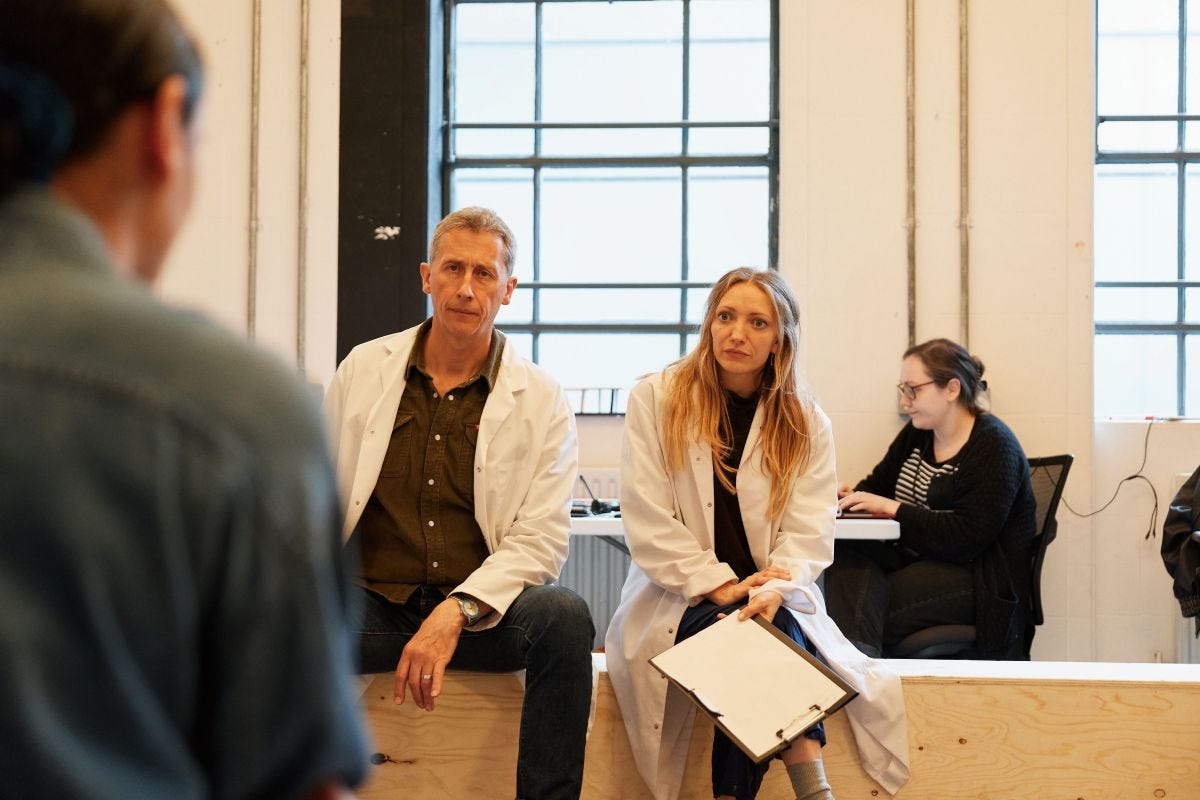
Tell me about Are You Watching? What is it about?
It is about online voyeurism, and what it means to watch and be watched in the digital age. It is a mosaic play of sorts with lots of short scenes, although there are recurring characters and recurring threads throughout. It interrogates our relationship to watching horrific things online. What does watching mean? Are we witnesses or bystanders? Are we complicit? Are we active or passive?
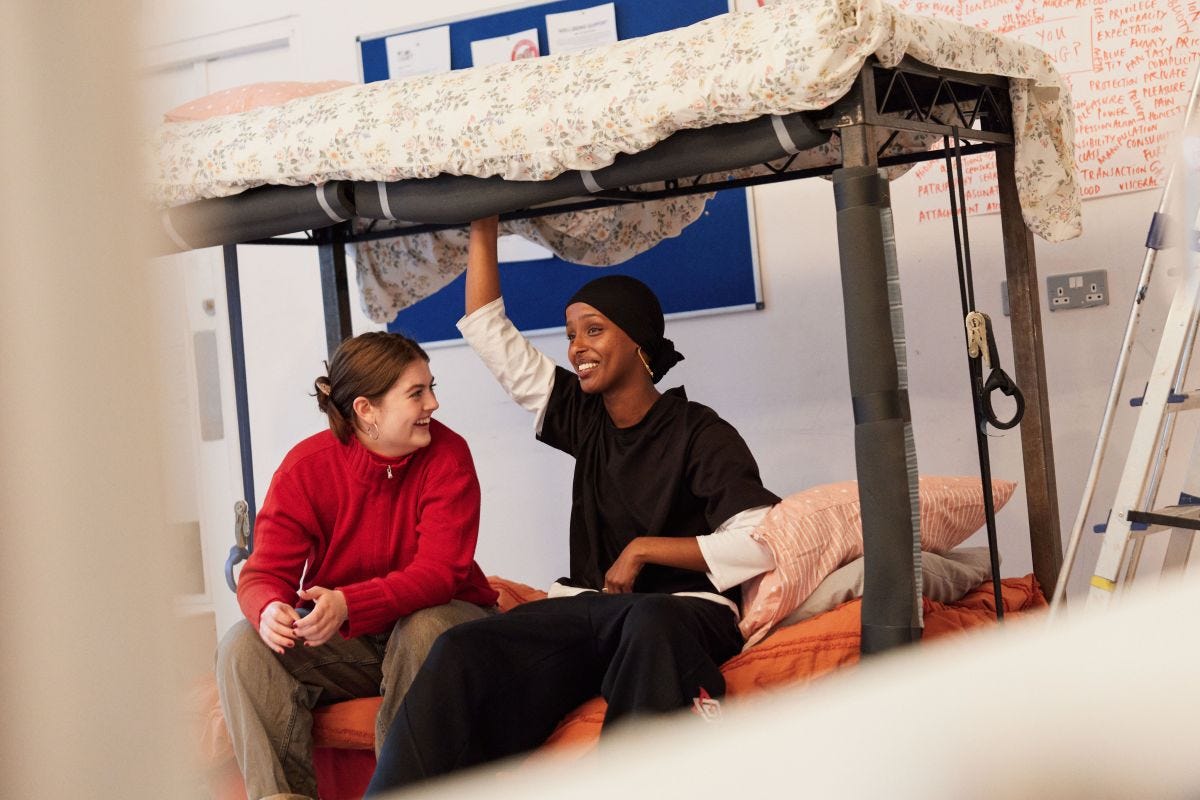
It is based around three main threads. One is a journalist who takes part in a sex experiment. One is a famous actress who is deep-faked. One is a mother whose daughter goes missing. All these things are subverted or ruined or sensationalised via the internet. And the backbone of the script is these two fifteen-year-old girls, who we keep returning to. They are having a sleepover, and over the course of the play, one of them reveals this story, inspired by the Gisèle Pelicot case, and her relationship to these videos.
Where did Are You Watching? come from? What inspired it?
I didn’t plan to write it. I’ve never written a play like it before. I was actually researching for another play and had done so much reading about the Giselle Pelicot case. I had seen so many horrific images of the genocide in Gaza, too, and thought a lot about my relationship to those images. One morning I just woke up and wrote this play the whole way through. Obviously, it is completely different to that first draft now, but it did just kind of blurt out of me. I came out of what I was seeing and reading, and my own anger and apathy, which kind of coexisted, and how I felt incredibly overwhelmed and hopeless, just sat watching these horrific things on my phone.
The play has an amazing cast, including Lucy McCormick, Maimuna Memon, Nicholas Rowe and Abby McCann.
It is an amazing cast. And I think the director, Jess Edwards, is amazing, too. We had a conversation about the play and it became so clear to me that she was the right person to direct it because of her ability to look after both the bodies of the actors and the text of the play. It is a play about violation and violence and horror, so it needed to be handled with interrogation and care. And humour, actually. That was a big thing I said at the beginning, that it has to be fast and it has be funny. Jess and the cast have really locked into that.

It does deal with really heavy topics. How did you cope with that in writing it?
The writing and the researching didn’t massively impact me. It is kind of normal, though completely abnormal, to be exposed to terrible things happening around the world now. In some ways, we feel compelled to watch, because if we don’t, what does that mean? Are we ignoring it? If I look at it too much, though, I feel awful and overwhelmed and inactive and sad. Weirdly, I find writing is a really amazing way to move through those horrid feelings. I actually find it harder to watch. I have watched quite a few runs now, and have found that really difficult.
Do you think our brains are just not evolved to cope with the amount of awful stuff we are exposed to via our social media and smartphones?
One hundred per-cent. I think that can’t be said enough. I did the Royal Court’s interview podcast with Lucy Prebble recently, and she was saying how the internet is such a new form. It’s only a few decades old. We are still coming to terms with this insane technology that has completely rewired the way that we engage with information and with each other. I am not anti-internet. This is not an anti-internet play. It does not lecture people about spending less time on their phones and getting out into the fresh air. That is not what this is about. It is about how overwhelming it all is. How are we meant to give our attention to all these important, horrific things, whether it is Gisèle Pelicot, or an entire family being wiped out by a drone attack, or something else? You have to pay attention to that stuff, but what are you supposed to do? Having the world inside a glass case is so weird and fucked up and paralysing. It makes us feel like we have no power, when we do. Obviously there is so much to say about tech giants and how much control they have and how unregulated they are, too, but that’s a different play.
Where did you grow up? How did you get involved in theatre?
I was born in 2000 and grew up in Hertfordshire. My mum got me into drama classes when I was young because she wanted me to be a confident public speaker, and I fell in love with them. I saw Blood Brothers when I was 12 or 13 and thought it was the best thing I’d ever seen, so I started writing plays in the style of Willie Russell, in this horrific, false Liverpudlian dialect. But I kept writing and I loved acting. I wanted to go to drama school, but my mum was a bit worried about that, so I went to do English at Oxford, and I did a lot of theatre there. I directed and produced and acted. I kept writing, too, although just for myself. I ended up president of OUDS [Oxford University Dramatic Society].
Not another one. Everyone I interview seems to have been president of OUDS.
It is worrying, isn’t it? After that, I did go to drama school. I did a year-long acting MA at Central. While I was there, I submitted a play to Bloomsbury Festival that won a prize. It was called Attempts On A Birch Tree and it was about a woman that falls in love with a birch tree. That inspired me to take writing more seriously. Then I submitted Are You Watching? to the Royal Court. I guess this is my big break.
One of your plays was longlisted for the Bruntwood Prize, too, right?
It was. That play was called Ordinary Sex, and that was the play that I had been researching for when I wrote Are You Watching?
What playwrights are you inspired by, apart from Willie Russell?
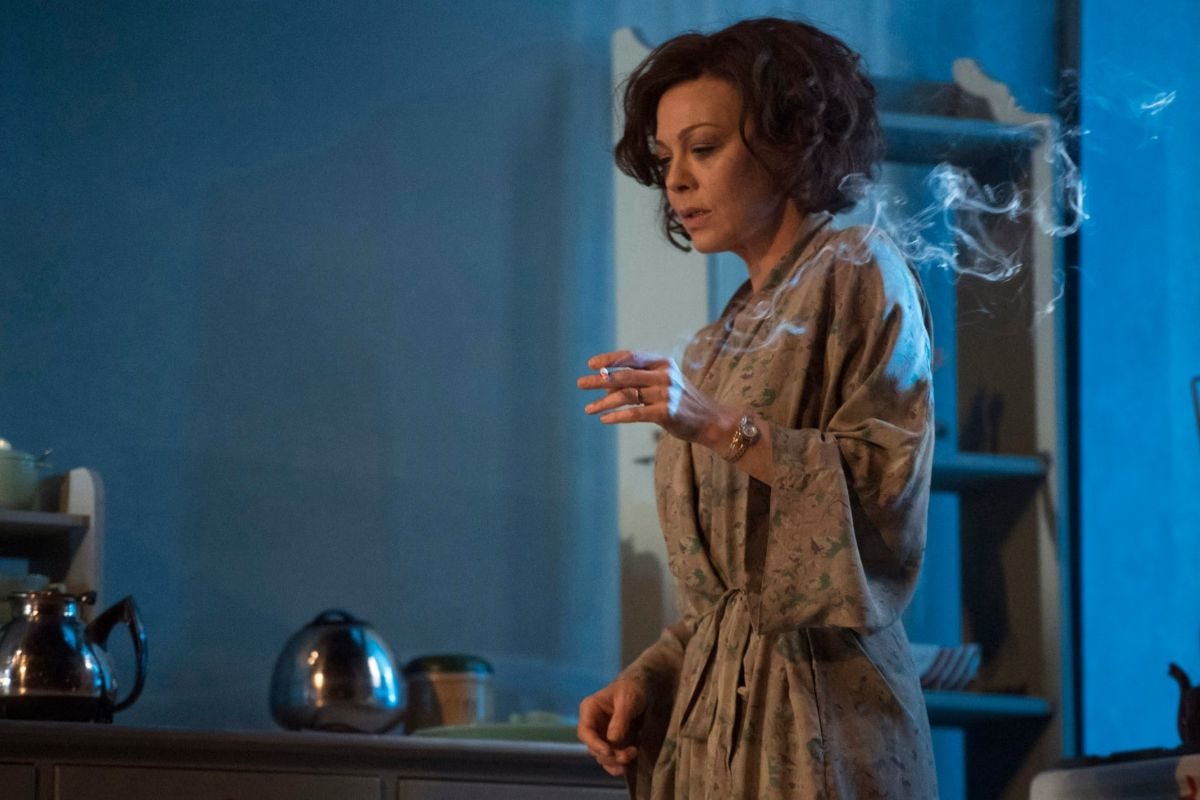
When I was younger, I used to say my favourite playwright was Terence Rattigan because I saw The Deep Blue Sea at the National Theatre and that blew me away.
Carrie Cracknell’s production? A lot of people tell me that show had a big impact on them. I had a long conversation with Luke Thallon about it before he played Hamlet.
That’s amazing. I love that. There was clearly something happening in that room. Helen McCrory is one of my biggest inspirations as an actor. Writing-wise, Sarah Kane is also a big influence. I committed one summer to read everything she wrote. I guess those are my big three, Willie Russell, Terence Rattigan and Sarah Kane. I also love Annie Ernaux and Alejandro Zambra.
Did you see The Years?
I did. It was so moving. I saw it at the Almeida and in the West End and I loved it. I am also inspired by theatremakers who do weird and wacky and amazing things. I love YesYesNoNo [Sam Ward] and Nathan Ellis. And I love Alice Birch and Ella Hickson and Lucy Prebble, of course. I went to see Revolt. She Said. Revolt Again. with my dad in Stratford upon Avon when it was first staged and I had a great argument with him in the car afterwards trying to explain it.

What? Did your dad not like it? Do we have to cancel your dad?
No, not at all. No hate towards him. He liked it a lot. I was just trying to explain it all to him.
What does life look like now? Are you a full-time writer?
I am not a full-time writer, but I would love to be. I tutor English to pay the rent. One of my students is actually visiting London with his mum today and he loves drama, so I am going to show him around the Royal Court. I just hope I can keep writing, to be honest. I am working on quite a few plays at the moment. I’m working on Ordinary Sex, which I would love to see somewhere. I am working on a play called Sycamore, which is inspired by the felling of the Sycamore Gap tree, but is actually about two teenage boys who want to lose their virginity. I just want to keep writing things that strike something inside me and hopefully offer something to the audience, too. I would like to do a bit of acting as well. I’d like to do acting and writing, with a bit of teaching sprinkled in.
What about acting? How big a part of your career is that at the moment?
I’ve done small bits. I had a small role in a film, which I got cut from, so I’m not even really in it. I do tapes and auditions. Sometimes I get little things like short films. It is chugging along. I love it, though, and I think it makes me a better writer.
How would you define yourself as a playwright? Do you think you have a mission?
I think it is too early to work out what my mission is. I think all creatives have something inside that propels us onwards, whether it is a desire to be understood or to feel less lonely, or whatever. Maybe I will work out what mine is when I’ve done a bit more. I know the things I care about, though, because they keep coming up in my writing. It is a lot to do with power and joy and pleasure and sex and women and the climate crisis. It is all the things that stress me out and that I don’t have answers to.
Are You Watching? runs at Upstairs at the Royal Court until July 4.
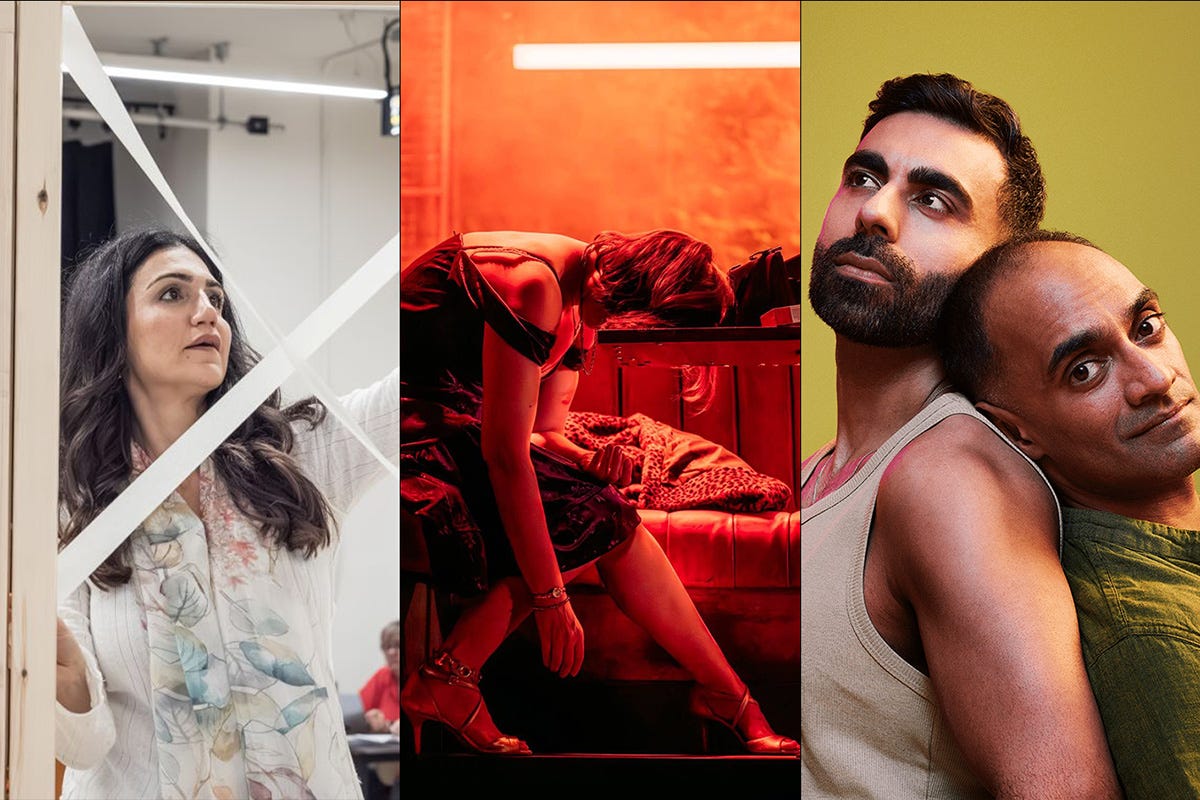
Three shows to see next week
Under The Shadow - Almeida Theatre, until July 4
Playwright Carmen Nasr and director Nadia Latif adapt Babak Anvari’s BAFTA-winning 2016 horror film about an Iranian mother trapped in her Tehran home with her young daughter, with bombs falling outside and a ghostly presence lurking inside. You can read my interview with Nasr here and get tickets via the button below.

Sweat - Lyceum Theatre, Edinburgh until June 13
Lynn Nottage’s Pulitzer Prize-winning drama about the fraying social fabric in a Rust Belt town made its Scottish premiere at the Citizens Theatre in Glasgow earlier this month. Now, Joanna Bowman’s hugely acclaimed production transfers to Edinburgh. You can read my interview with Bowman here and get tickets via the button below.

The P Word - Bush Theatre, until June 27
In 2022, Waleed Akhtar’s The P Word premiered to acclaim, going on to win an Olivier Award the following year. Now, the play, which focuses on a gay romance between a British Pakistani and a Pakistani asylum seeker, is back at the Bush Theatre. You can read my interview with Akhtar here and get tickets via the button below.

Thanks for reading and supporting The Crush Bar
Thanks to all 5029 subscribers, to all 156 paid supporters, and particularly to The Crush Bar’s champion supporters, whose contributions make all this possible.
The Royal Court Theatre, Francesca Moody Productions, Raw Material Arts, Jermyn Street Theatre; Hampstead Theatre; Storytelling PR; Premier Scotland; Ellie Keel Productions; The Women’s Prize For Playwriting
Your organisation can become a champion supporter of The Crush Bar, join that list, and help keep its independent coverage of theatre going via the button below.
That is it for this week. If you want to get in touch about anything raised in this issue - or anything at all - just reply to this newsletter.
Fergus