
Hello, and welcome to The Crush Bar, a newsletter about theatre by Fergus Morgan.
This is the free Friday issue, which usually contains an interview with a theatremaker or an essay on a theatre-related topic. This week, it is a chat with director, writer and occasional performer Tatenda Shamiso, whose production of Joy Nesbitt’s Blood Of My Blood is currently running at the Royal Court. After that, there are your usual three show recommendations for next week: one in London, one Scottish tour, one UK tour.
In case you missed it, here is this week’s issue of Shouts and Murmurs, which is a weekly round-up of the most interesting writing about theatre elsewhere…

You can get Shouts and Murmurs straight in your inbox every Tuesday - and help keep this newsletter going! - by signing up as a paid supporter of The Crush Bar.
Theatres, companies, agencies and other organisations can also sign-up as champion supporters of The Crush Bar, which gets their name in this dedicated tab on The Crush Bar’s Substack homepage and in the footer of every Friday issue, plus full access to The Crush Bar and Shouts and Murmurs for ten different emails.

Tatenda Shamiso has been involved with some buzzy, brilliant shows in recent years.
He was an associate director on Ryan Calais Cameron’s sensational For Black Boys Who Have Considered Suicide When the Hue Gets Too Heavy. He assisted Rebecca Frecknall on her celebrated staging of A Streetcar Named Desire with Paul Mescal and Patsy Ferran. He staged Jade Franks’ smash-hit solo show Eat The Rich (but maybe not me mates x). Now, Shamiso is starting to establish himself as a freelance director: his production of Joy Nesbitt’s new play Blood Of My Blood opened at Upstairs at the Royal Court this week, and he will be directing Troy Hunter’s debut play There’s Something About Adam Black at the Yard Theatre in January.
Raised in California, with a Zimbabwean mother and a Belgian father, Shamiso moved to the UK to study at Goldsmiths as a teenager, then stuck around. Now based in East London, he also works as a writer and occasional performer in addition to his directing career, most notably with No I.D., an acclaimed autobiographical solo show about his former identity, his transitioning journey, and his struggle navigating the bureaucracy involved, which ran at Theatre Peckham in 2022, then at VAULT Festival in 2023, then at the Royal Court later that year, landing Shamiso the Emerging Talent prize at the Evening Standard Theatre Awards.
Blood Of My Blood opened Upstairs at the Royal Court earlier this week to some glowing reviews. You must be thrilled by the reception?
I absolutely am. It’s been quite a bit of work wrestling such a big show into a studio space, and I’m really grateful that work feels like it’s paying off.
How did the production come about?
Joy and I first met early last year. She had seen A Good House by South African playwright Amy Jeptha at the Royal Court, which I was associate director on. She was scrolling through the internet to see who had made it and came across my Instagram. We ended up meeting for coffee in King’s Cross and hit it off. She’s a theatremaker from the US living in London, too. We were like ships in the night for a while. She sent me a much earlier draft of what became Blood Of My Blood, which I actually never read. I had been in chats with the Royal Court for quite a while. I did No I.D. here and was associate on For Black Boys and A Good House, so I had just been in and out of the building in various capacities for a few years. I had wanted to get my hands on a show there for a while, and Blood Of My Blood was the first one they sent me. I was, like: ‘Oh, I know her!’
What is Blood Of My Blood about?
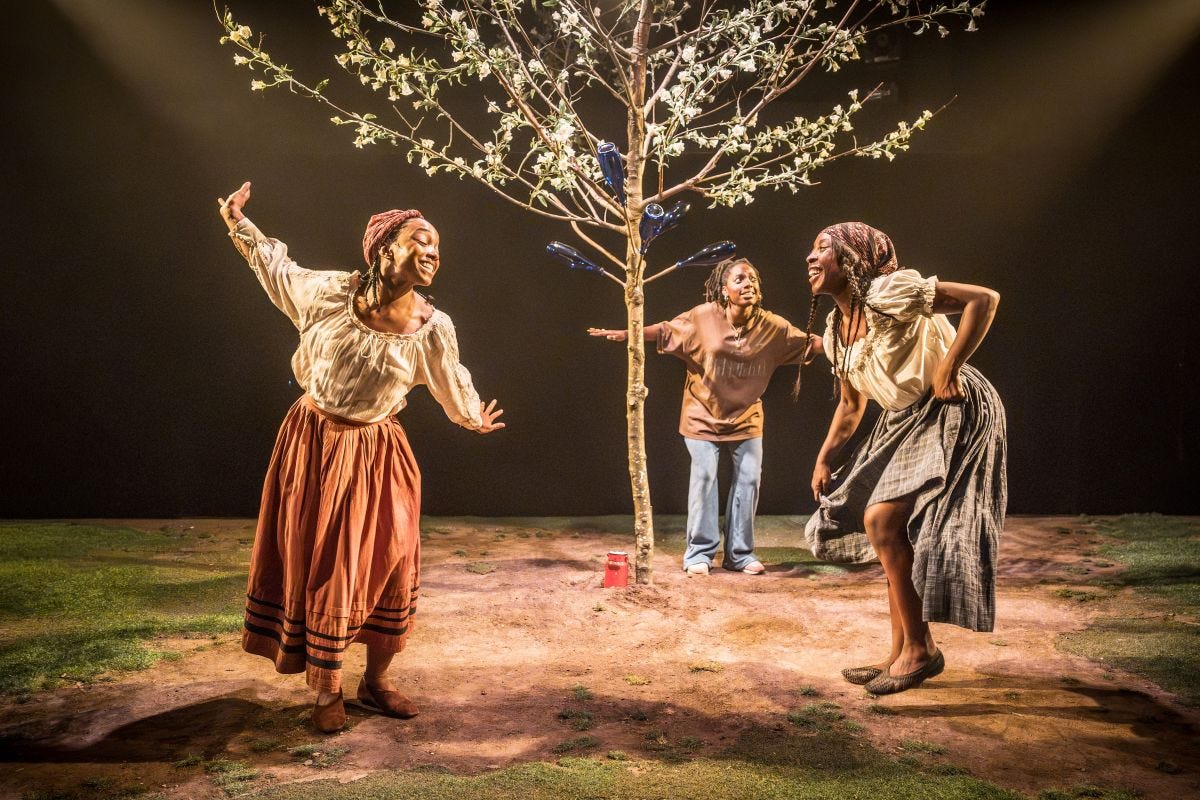
It’s about a Black British woman who visits a plantation-turned-AirBnb in South Carolina to stay in one of the cabins that enslaved people once lived in, which has been turned into a tourism experience, and she gets a lot more than she bargained for in an attempt to connect to an ancestor of hers while she’s there. It’s about what it takes to survive in those circumstances, and what it is to have a claim on such bloody soil, when everybody is entitled to that space in such different, troubling, complicated ways, and what to do with that legacy going forward. It’s a conversation about ancestry and agency and dignity and black women and survival. More than anything, it is about two women connecting across centuries.
Apparently former plantations are really turned into holiday homes and venues?
They are. Blake Lively got married on a plantation. It is super common because they are massive, beautiful pieces of architecture. I guess if you can divorce yourself from why its there and what it represents, then maybe it is a great place to have a big party with your friends and family. I can’t possibly relate, but okay. The character’s lineage in the show is Joy’s lineage, too. Her fifth-great-grandmother was enslaved on a plantation and had a relationship with her enslaver. They were together for six decades. It’s all very authentic to her family history.
Why were you attracted to the play as a director?
Well, when I first read page one and saw that it was set on a plantation, I was immediately, like: ‘No, absolutely not. I don’t have an interest in trauma porn. We’ve all seen 12 Years A Slave.’ Growing up in the US, slavery and its legacy is so present in your educational experience, so anything set in that world becomes quite a hard sell. By the time I got to page five, though, I realised Joy was doing something more interesting in that space than anything I’d experience before.
It posed a challenge for me as a director, too. We had to immerse our audience in that world, which they don’t want to be in, but assure them that we are provoking a conversation that they haven’t had yet. We’re dealing with old and, in some ways, tired subject matter, but we’re here to do something fresh and exciting and moving. The play has this ancestral veneration ritual in it, too, and as that ritual starts working, the play’s two timelines start bleeding into one another. I was interested in exploring and decolonising our notions of those spiritual traditions and I was thrilled by what the visual world of the play could look like.
How did you go about realising that visual world?
Joy definitely made it hard. I really do try to take the page as the manual for a production, especially when its new writing. We are doing the world premiere of a playwright’s work. I want to do it in a way that it might get staged again in a few years. I want to achieve what it says on the page, but Joy had written stuff like: ‘A light flickers and this person vanishes.’ I was like: ‘Vanishing someone? Upstairs at the Royal Court? Okay, let’s try it.’
Did you manage it?
God, no, but we gave it a good go. With the help of our brilliant designer Natalie Pryce, we spent a lot of time figuring our what the gesture that the words are trying to achieve was, then realising that with the resources in our arsenal. The play is quite staccato to begin with. We’re here, then we’re there, then we’re here, then we’re there. The longer the play goes on, though, those two spaces begin to merge. We decided to stage it in traverse, so it works like a tennis match, and as the match goes on, the players get closer and closer until they are touching.
You have a phenomenal cast, too: Ronkẹ Adékọluẹ́jọ, Jodie Campbell, Hannah Morrish, Karene Peter, and Patrick Vaill. It must have been a sparky room?
It’s a real blessing. The Royal Court is such a beautiful playground for fresh ideas and vulnerable storytelling, and the cast is incredible. Sparky is exactly the right word to describe the rehearsal process. It was one of those rooms where offers and ideas were constantly flying around. I really love a highly collaborative process.
You mentioned how the play deals with familiar subject matter in a fresh way. What do you mean by that exactly?
I think that the thing Joy offers in this play, which I think is missing in the context of British theatre and Black history, and in the context of the world generally, actually, is empathy. She affords her characters so much patience and clarity and compassion, even ones that you want to paint as villains immediately. She does not give audiences the luxury to sit comfortably. She writes characters with agency, but limitations on that agency. They have choices, but not as many as they want. Even the relationship in the play between the plantation owner and the enslaved woman, for instance, is not the cut-and-dried abusive relationship you might expect.
You have to be careful not to come across as a slavery apologist, though?
Absolutely. There is a very tender balance between having empathy for your characters and allowing them humanity, and not romanticising an interracial antebellum non-consensual relationship. Sitting in that pocket is a very uncomfortable place to be.
It is a brave place to be, though, and an important place to be, particularly when contemporary cultural discourse is so glib and polarising, right?
Totally. That is what I think Joy is offering to our contemporary theatrical or cultural discourse. She is offering an opportunity not to paint anyone as a hero or a villain or a victim or a saviour. All of her characters are fundamentally flawed but also, in a way, lovable. I feel sorry for everybody in this play at least once, and pissed off with everyone at least once. We are not giving people an opportunity to turn off their subjectivity, and I think that really matters.
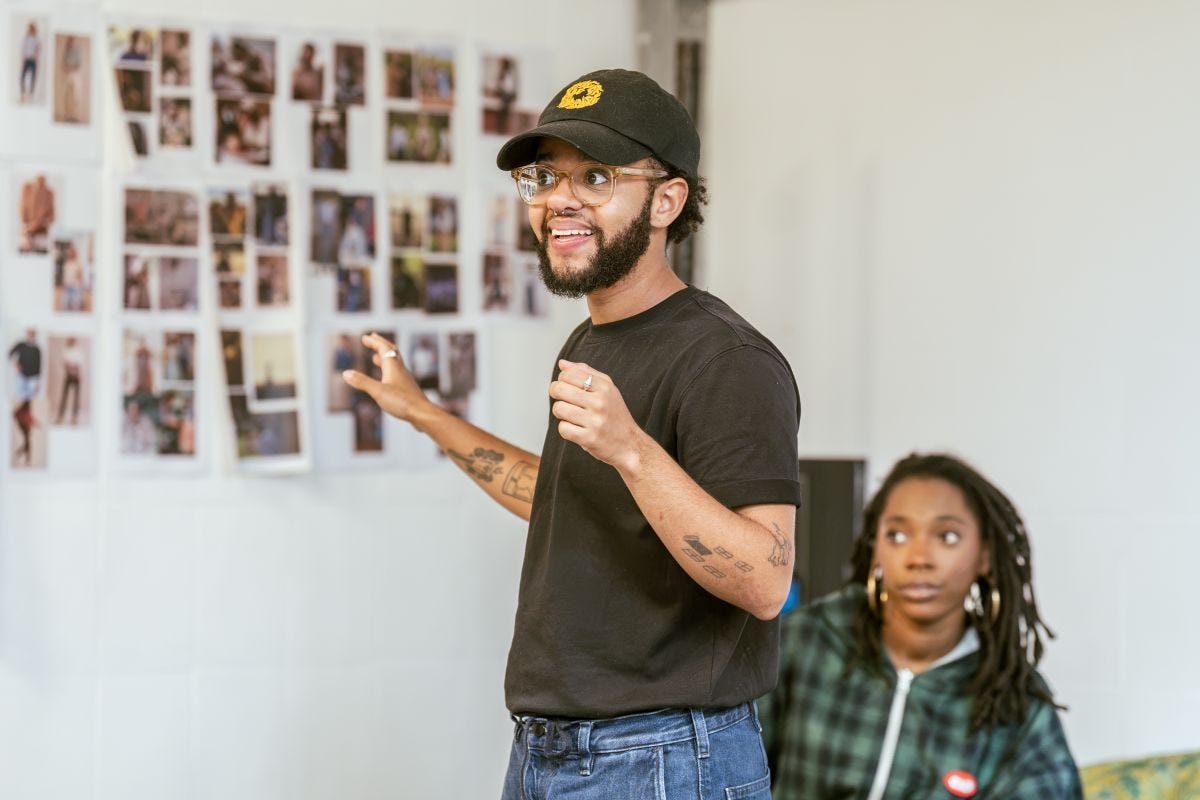
In January, you are directing Troy Hunter’s debut play There’s Something About Adam Black at the Yard Theatre, too. Tell me about that.
It’s a two-hander about a young, Black, queer man who has been living in a revolving door of Grindr hook-ups, pushing down a lot of the vulnerable, scary, gooey stuff that makes him who he is. Then he meets this poet from Yorkshire who forces him to face the reality of his life. It’s a romance. It’s a bit genre-defying at times. It’s wacky, it’s tender, it’s a little bit scary and it’s a little bit raunchy. It’s going to be really fun. And it is quite the departure from Blood Of My Blood.
It must be nice to have your next directing job already lined up.
It really is. This is the first year where I came into it and knew what I would be doing, which was magical. I pray that continues.
You have worked as an assistant and associate director, too, on A Good House at the Royal Court, on Wolves On Road at the Bush Theatre, on For Black Boys in the West End, on A Streetcar Named Desire at the Almeida Theatre. Do you think that chapter of your career is over now?
Regardless of where I am in my career, I think it is important to leave that door open for other people that need those opportunities. I definitely still have so much to learn. I absolutely still consider myself a student of the game. And there are people like Nancy Medina that I would assist and work as an associate with any day because they have such brilliant minds. However, I know there are people at the same point in their career as I was when I started getting those jobs, and I want those opportunities to be available to them. I certainly don’t turn my nose up at associate work because I find it a really worthwhile and fulfilling job. I love seeing the gaps in a show and filling them with life to help create the three-dimensionality of a project. However, I am now really enjoying constructing worlds for myself. I still write and I perform every now and then when the occasion calls for it. My directing practice is growing, though, and I’m excited to see what that means going forward.
Tell me about working on A Streetcar Named Desire with Rebecca Frecknall.
That was my first professional assisting gig and it really felt like a baptism of fire. Rebecca Frecknall is such a brilliant artist and such a brilliant person and I learned so god damn much from her. That entire company was brilliant. I felt, like: ‘If I can walk among these titans and do this stuff, then I’m going to be okay.’
Did you give Paul Mescal any direction?
Paul Mescal got a couple of notes from me. We worked on some stuff. He’s a really wonderful, collaborative actor, and he actually has a really directorial brain. There are some actors that live in the moment, who you have to remind that there is other stuff going on around them, but Paul can think of things from a kind of bird’s eye view at the same time as that. He’s a brilliant stage actor. I’m so happy he and Rebecca are doing another stage project soon. Anjana Vasan was amazing as Stella, too, and Patsy Ferran, who took over from Lydia Wilson when she got injures, absolutely swept up on the awards circuit that year.
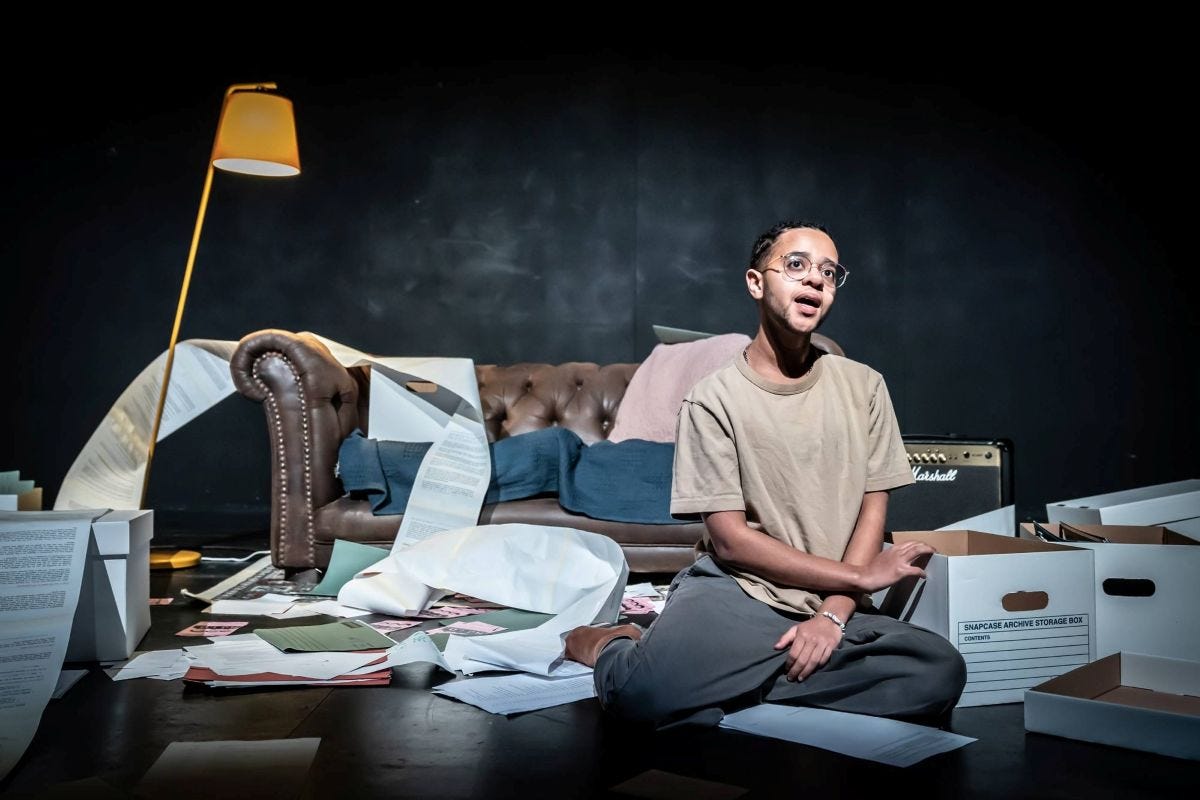
You created the solo show No I.D., too, and performed it at VAULT Festival and the Royal Court. It was a personal story of your former identity, your transition, and your Kafka-esque nightmare navigating the bureaucracy of that, right?
Exactly. It was an autobiographical solo show, which I wrote and performed, largely about getting my name and gender changed as an immigrant, which is still an ongoing issue. I’ll let you know when I finally get my passport.
No I.D. got some wonderful reviews as well. Will it have another life?
I am adapting it for television at the moment. It’s a slow process because I’m always in a rehearsal room somewhere, but it is underway. I’m working on it with Fifth Season, who produced Severance, and hopefully it will be going out to commissioners relatively soon.
Was it therapeutic to work through all that stuff in a show?
Definitely. It’s been much easier to make art about the problem than actually solve it. I probably should have invested more energy in filling out paperwork than making theatre, but here we are.
You also directed Jade Franks’ solo show Eat The Rich (but maybe not me mates x), which was a huge hit at the Edinburgh Fringe last year and its now being adapted for television, too. You seem like quite an unlikely choice of director for that.
I know. I was as surprised as anybody when Jade asked me to do it. I’m not from England. I had never been to Liverpool. I had been to Cambridge maybe once. It was totally outside my frame of reference but I actually think that ended up being a bit of a superpower because a lot of the show’s audience would also not relate to the Scouse cultural aesthetic or the Cambridge cultural aesthetic. Having someone involved that also had zero understanding of those worlds was actually quite helpful. I am not attached to the show anymore, though. It is Jade’s story, and always has been. I was grateful to be able to facilitate its journey through the Fringe circuit, but now it is very much time for her to go fly with Netflix.

Where did you grow up? How did you get into theatre?
My mother’s from Zimbabwe. My dad is from Belgium. I grew up mostly in California. I started in theatre really young. I did my first professional show twenty years ago at the age of six.
You were a child performer?
I was, yeah. A friend of mine was a ballerina and wanted to do some kind of theatre summer camp. I couldn’t imagine anything worse at the time, but I did it with her, and, lo and behold, theatre became my entire universe. I started working semi-professionally from the age of six, then I started directing in my late teens. I then moved to London to study at Goldsmiths when I was eighteen, and I’ve stuck around ever since.
Why did you choose to study and build a career in London?
My family moved from California to Switzerland when I was a teenager. When the time came for me to go to university, I wanted to stay close to my little sister, who is really important to me. At the time, Brexit hadn’t Brexit-ed very hard, so I had the choice of spending, like, £60,000 a year for four years on training in the US, or as a Belgian citizen, spending £9,000 for three years in London. And where better in the world to study theatre than London? When I graduated, I had made so many wonderful professional and personal connections here, and I wasn’t ready to leave. I’m still not ready. I feel like it would be a crazy sacrifice to go anywhere else right now. I do feel a hankering to make work back home at some point, but the time for that will come.
Tell me about your theatrical education. What shows and artists have you been inspired by?
When it comes to stagecraft and theatre artistry, a lot of that came from practical experience as a child performer, but when it comes to the craft of directing and creating work, I think all that came from my time here in London. One of the first shows I saw when I moved here was Rebecca Frecknall’s production of Summer and Smoke, with those nine pianos in a horseshoe. I then found out that Rebecca went to Goldsmiths like me. We actually share a really brilliant directing mentor, Cass Fleming. She introduced us and that is how I ended up working on Streetcar. Rebecca is a massive inspiration for me. So is Nancy Medina. So is Lynette Linton, and not just for the way she directs shows, but for her leadership at the Bush Theatre when she was artistic director. Being an artistic director is an ambition of mine, and that is the kind of leader I want to be.
Blood Of My Blood is at the Royal Court Theatre until November 7. There’s Something About Adam Black is at the Yard Theatre from January 13 until February 20.

Three shows to see next week
The Hungry Ghost - Bush Theatre, until October 31
Mei Leng Yew’s debut play at the Bush Theatre is a “sexy horror rom-com” about a young woman wrestling for control of her body with an ancient spirit she accidentally invoked by taking a big decision during the Chinese Festival of Hungry Ghosts. Directed by Ailin Conant, it stars My Neighbour Totoro’s Mei Mac and Bridgerton’s Isabella Wei, and has earned some glowing reviews, with The Guardian’s Kate Wyver giving it four stars and labelling it “a seductively assured debut about second-generation family dynamics, the all-in nature of a new relationship, and the internal battles of a young woman trying to work out what she wants.” You can get tickets via the button below.
Contact - touring, until October 23
Earlier this year, Jonny Donahoe was at the Tony Awards, where Every Brilliant Thing was nominated alongside its Broadway star Daniel Radcliffe. Now, he has swapped the glitz and glamour of New York for the beers and pastries of Glasgow: his new play Contact is the sixth show in A Play, A Pie and A Pint’s autumn season. It is an amusing, angsty, emotionally insightful two-hander about an estranged mother and son attempting to reconnect ahead of the latter becoming a father. Ben Standish, a rising star of Scottish theatre, directs intelligently, and Blythe Duff and Mark Barrett provide detailed, pained performances. It is at Oran Mor until tomorrow, then the Traverse Theatre next week, then Paisley Town Hall. You can read my four-star review in The Stage here and get tickets via the button below.
It Walks Around The House All Night - touring, until November 14
Playwright Tim Foley work includes the Bruntwood Prize-winner Electric Rosary, the fraternal two-hander Driftwood, the campus comedy Jurassic, and dozens of audio dramas, including Murder On Mars on BBC Radio 4. This autumn, his one-man ghost drama It Walks Around The House At Night, which premiered to acclaim last year, is off on an extensive UK tour directed by Neil Bettles and produced by his company ThickSkin. It is in Edinburgh over the weekend and Glasgow next week, then heads to Norwich, Coventry, Newcastle and elsewhere. You can read The Crush Bar’s interview with Foley here and get tickets via the button below.

Thanks for reading and supporting The Crush Bar
Thanks to all 5233 subscribers and 150+ paid supporters, and particularly to The Crush Bar’s champion supporters, whose contributions make all this possible…
The Royal Court Theatre, Francesca Moody Productions, Raw Material Arts, Jermyn Street Theatre; Hampstead Theatre; Storytelling PR; Premier Scotland; Ellie Keel Productions; The Women’s Prize For Playwriting
Your organisation can become a champion supporter of The Crush Bar, join that list, and help keep its independent coverage of theatre going via the button below.
That is it for this week. If you want to get in touch about anything raised in this issue - or anything at all - just reply to this newsletter.
Fergus