
Hello, and welcome to The Crush Bar, a newsletter about theatre by Fergus Morgan.
This is the free Friday issue, which usually contains an interview with an exciting theatremaker or an essay on a theatre-related topic. This week, it is a Q&A with Australian clown Damien Warren-Smith, AKA Garry Starr, whose incredible show Garry Starr: Classic Penguins is doing eleven performances at the West End’s Arts Theatre before Christmas, starting this weekend. After that, there are your usual three show recommendations for next week: two in London and one in Scotland.
In case you missed it, here is this week’s issue of Shouts and Murmurs, which is a weekly round-up of the most interesting writing about theatre elsewhere…

You can get Shouts and Murmurs straight in your inbox every Tuesday - and help keep this newsletter going - by signing up as a paid supporter of The Crush Bar.
Theatres, companies, agencies and other organisations can also sign-up as champion supporters of The Crush Bar, which gets their name in this dedicated tab on The Crush Bar’s Substack homepage and in the footer of every Friday issue.
One last piece of housekeeping: there will be no issues next week, as I’m taking a short break from the newsletter. Regular service will resume on 11 November.
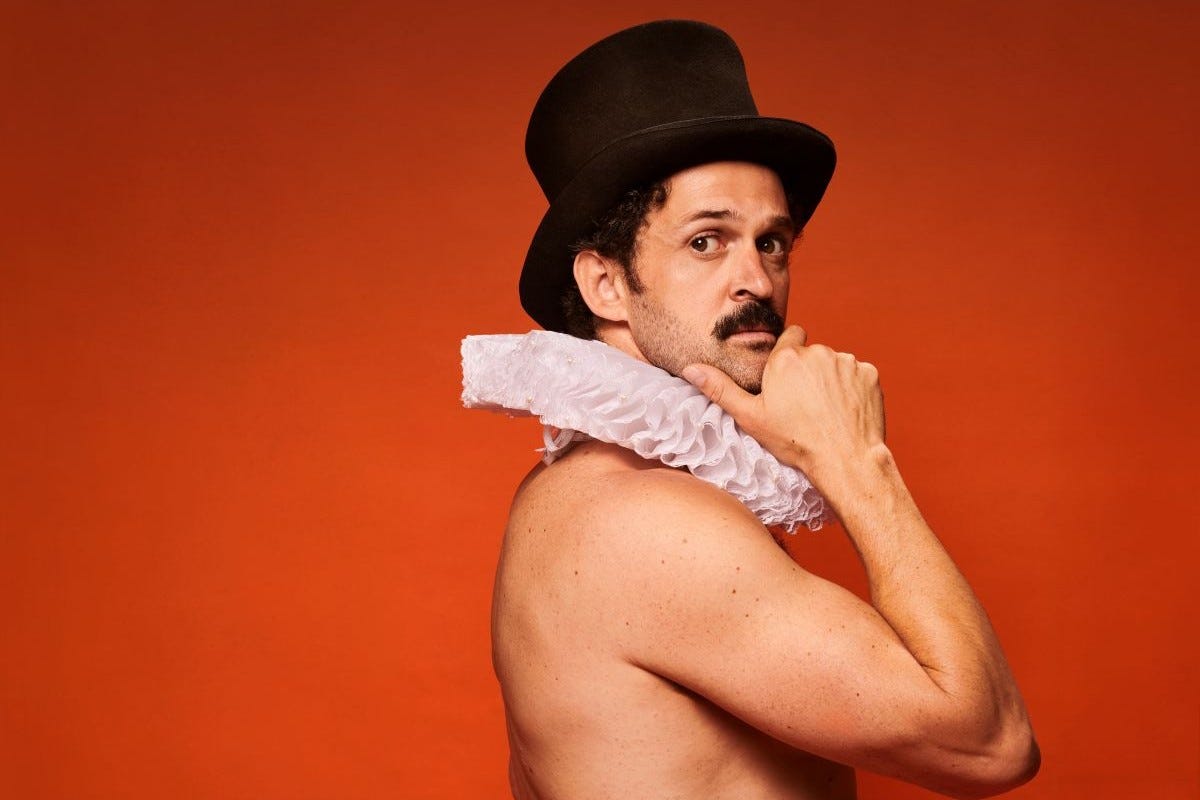
Garry Starr: Classic Penguins is one of the most joyously jaw-dropping shows I’ve ever seen.
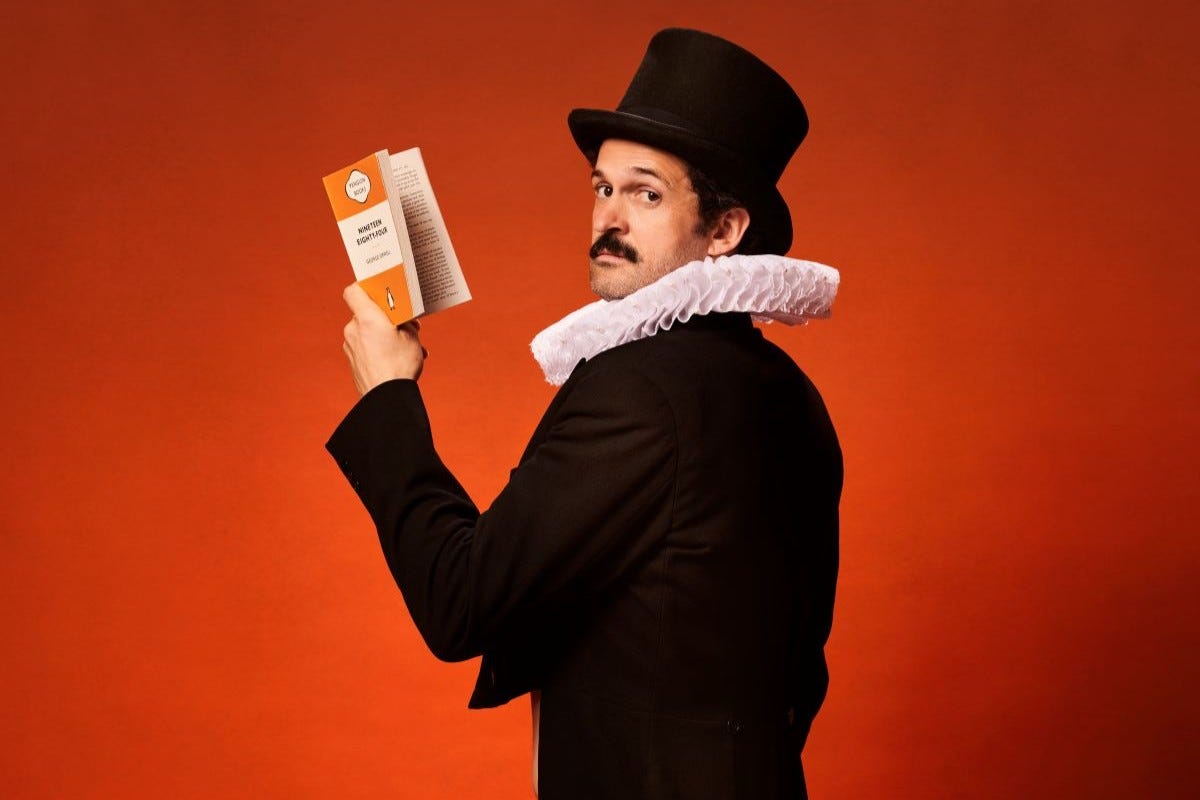
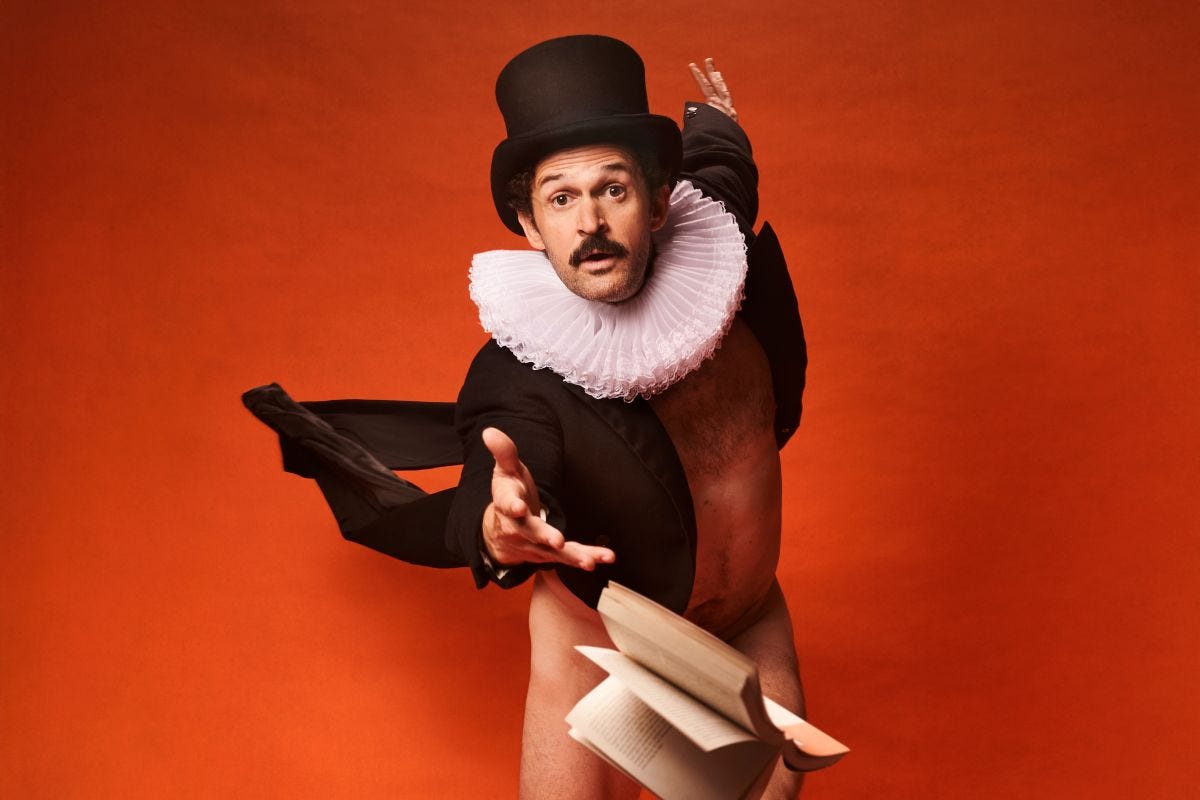
In it, Garry Starr - the clown alter-ego of Australian performer Damien Warren-Smith - undertakes a mission to act out every great work of literature published by Penguin Classics. What this actually involves is a series of increasingly insane gags riffing on the books’ titles or plots, frequently involving audience members doing incredible things. For Gulliver’s Travels, he tapes someone to the floor. For War and Peace, he stages a food fight. For The Bodysurfers, he manages to crowd-surf across the auditorium. It is a work of supreme silliness - one of several that took this year’s Edinburgh Fringe by storm, prompting my colleagues Tim Bano and Holly Williams to coin the term ‘sexy chaos clowns’ - but one conceived with genuine care. Oh, and Starr is entirely naked for the duration, save for a top-hat, tailcoat, and flippers.

Warren-Smith was born in Inverness to an English dad and an Aussie mum, but relocated to rural New South Wales when he was young. He trained at Actors Centre Australia in Sydney, then moved back to the UK, where he worked as a jobbing actor for several years before he discovered clowning. His first two shows as Garry Starr - Garry Starr Performs Everything and Greece Lightning - were hits, but Classic Penguins has reached another level of success. Directed by Cal McCrystal, it first ran at the Edinburgh Fringe in 2024, then went on a tour of Australia, then returned to the Fringe this year, picking up awards galore along the way. Now, under the aegis of Fleabag’s Francesca Moody, Australian outfit MILKE, and production company Fiery Angel, it arrives in the West End, with dates at the Arts Theatre until mid-December.
Classic Penguins has become a massive hit. Are you surprised by its success?
It has been a bit of a surprise. The first couple of shows I made were good and I could feel them growing and growing. This one, though, right from the first work-in-progress, felt wildly different. That first performance was just me on stage with a pile of books doing random stuff. Afterwards my manager said to me: ‘This is it. This is going to be your best one.’ And she was right. It has just grown and grown from that point. Even since you saw it at the Edinburgh Fringe, it has gone up another level. I’ve just done six weeks in Sydney and they had a rigging point in the theatre, so I said: ‘Can I use that?’ And now there is a flying section for Wuthering Heights. I’m not sure we can do that at the Arts Theatre, though.
It is still growing, too. You’ve just added six more dates in the West End.
It really is. I’ve not felt a snowballing like this ever before. It’s very organic, too. It’s not growing because I’m good at social media or because people are writing good reviews, although they are. It is growing because people come see the show and then want all their friends and family to see it, too, so they buy them tickets. That was particularly the case in Edinburgh, because word of mouth spreads so quickly there, like Covid. Anywhere else, it takes a little bit longer, but it does ramp up.
It is the sort of show that sounds bonkers when you explain it to people, so you just end up saying: ‘You have to see it.’ Can you feel that energy when you are on stage?
You can. That shifts throughout a run, too. At the beginning, there are people who really don’t know what they are walking into. Then it changes and more people know what to expect because they have been told. I don’t think that ruins it, though, because the show is different every time, depending on the audience.
Where did the idea to base a show around classic novels come from?
A bookshop. I was looking for a new theme for a show. I have a few rules. It has to be a broad topic where there is a lot of content that the general public know about, and it has to be high-brow enough so that when I get it wrong, I’m not punching down. The first show I did, for example, was me doing every genre of theatre in an hour. The second one was all of Greek mythology. For the third one, I wanted to do the Bible, which would have been hilarious but might have upset some people. Then, I was in a bookshop, and I saw those Penguin spines, and I thought: ‘That’s it.’ I let it stew in the back of my mind for a while, then I started dreaming it up.
How did you go about creating it?
I made a list of all the books that I know, and what I know about them. I didn’t study literature or anything, so I didn’t know a huge amount, but that was kind of perfect. If I knew too much, it would become an in-joke. Then the next step was to imagine how Garry could get that wrong. Some were just riffs on the title. For Great Expectations, I just wrote: ‘Set up that you’re going to do something, then don’t.’ For One Flew Over The Cuckoo’s Nest: ‘Set someone up as a bird in a nest and jump over them.’ For Jane Eyre: ‘You’re a woman name Jane but your entirely airborne.’ Some were really stupid and didn’t make it into the show, but some did.
You must have been nervous the first time you tried it out.
I don’t really get nervous, particularly with a work-in-progress because mostly it is all people who have seen my stuff before, and they are just willing me to succeed. I would try something, see how it went, then move on. I think I’m okay with failure. One of the beautiful things about clown is that not only do you become okay with failure, you start to seek it out. And, as long as you are genuine and don’t panic, the audience like seeing you struggle through something and figure it out. And from there, it is just about tightening bits, filling gaps, cutting stuff. Cal McCrystal, who directs the show, is quite insistent that if something isn’t working, it goes.
One thing that really struck me was how brilliant you are at working with an audience. You get some people to do ridiculous, amazing, disgusting things in the show, but you also make sure no-one ever does anything they really don’t want to do.
Yeah. Consent is not as simple as a ‘yes’ or a ‘no’ in this situation. A lot of the time, it is about reading someone’s body language. You can tell if someone really doesn’t want to be doing something. I’ve also learned that if someone is avoiding eye-contact or says ‘no’ at first, that doesn’t necessarily mean they don’t want to be involved. It is a delicate balance and it is risky because everyone is really aware of consent. We have done the show over 200 times now, though, and we have never had a single complaint. I have never even heard of someone saying they didn’t think something was okay. That is one of the biggest compliments. Hopefully, no-one has ever felt obliged or humiliated, and that even if they do something they didn’t want to do at first, by the end of the show, they are glad that they did it.
Have you got more skilled at that interaction over time?
I have got better at it, but it was never about going big and getting it wrong. It was always about starting small and building it up. In the first show, I didn’t ask a lot of people. As I went on, I realised I could ask more and more and more from people.
Until you are able to get an audience to crowd-surf you across a theatre, naked. That was the one moment in the show that I thought you were kidding, but you weren’t.
When I first had that idea, I didn’t think I could get away with it, but there is quite a few things like that in the show. I didn’t think I could drink a litre and a half of tomato juice every night. I didn’t think I could spin around 80 times every night. I didn’t think I could jump over an audience member or get an audience member to volunteer to be naked. I thought I was going to have to use loads of plants in the show, but then I tried it and got away with it. And I just kept doing it and doing it.
The stuff you get people to do is incredible. Has someone ever really surprised you?
In Sydney, for The Little Prince at the end [when an audience member is invited to find a figurine hidden between Garry’s bum cheeks] the guy that got up didn’t see it and couldn’t work out was was expected of him, so he just grabbed my junk. Everyone was like: ‘No!’ He came up to me afterwards and was like: ‘I’m so sorry.’ I’m not upset about things like that, though. I remember my producer asking me if I was worried about the crowd-surfing. I was like: ‘What’s the worst that can happen? Someone sticks their finger up my bum?’ And she’s like: ‘Yeah, that’s pretty bad.’ And I’m like: ‘Ah, I think I’d be okay with it.’ Then I realised that when you are doing that, everything is so clenched anyway so there is zero possibility.
You trained in Australia, then worked as an actor in the UK for several years. When did you discover clowning?
I first saw a clown show in Edinburgh, not during the festival, at the Traverse Theatre in 2009. I think it was Spymonkey. I’d never seen one before and I was like: ‘What is that? I want to do that.’ From there, I dug around and found clown teachers in the UK. I worked with Peta Lily, Mick Barnfather, John Wright, Lucy Hopkins. I did workshops with a bunch of people, then I went to France and trained with Philippe [Gaulier]. After that, I started making my own work.
Where did Garry Starr come from?
I was part of a clown troupe called The Plague Of Idiots. At first, my clown was just called Monsieur. Then a director said he should have a name. I said, ‘Gary.’ Someone asked me what his last name was. I said, ‘Starr.’ Someone else suggested it should have two ‘R’s. I was like: ‘Which name?’ And they were like: ‘Both.’
We all went our separate ways and I ended up living in Berlin, where I started playing around with Garry Starr as a solo character. I found pretty quickly that I was enjoying it. The audience seemed to like him. Everything grew from there.
I read in another interview that Garry Starr is just you without any inhibitions.
He is not so much a character as an alter-ego. It’s like Beyonce. Beyonce is not her real name, but it is what she needs to call herself in order for her to be that version of herself. That is what I feel Garry is for me. When my mum came to see the show, she spotted all these mannerisms I had as a child. She asked me: ‘Did you know you were doing that?’ And I didn’t, so I’ve definitely tapped into something.
Did your mum like the show?
Yeah. She loved it. My brother is a bit unsure. He is a bit embarrassed by it.
You often hear the argument that “political correctness has ruined the Edinburgh Fringe” or that “woke has killed comedy.” I think that is total nonsense. Your show, and others like it, break so many boundaries without ever being wilfully offensive. I think anyone that says that stuff just has a really narrow conception of comedy.
That does make sense, but I do wonder what might change over time. I wonder if people will look back on this and say: ‘That wasn’t okay.’ I know, and my audiences know, that everything that happens in the show is beautiful and wonderful and celebratory, but was that how stuff in the past felt, too? Maybe books will disappear and everyone will be like: ‘I can’t believe you made fun of them.’
It seems like there is a new wave of weird work happening right now. Why is that?
I think people are seeking out really silly stuff right now because there’s a lot of shit going down around the world. When times are tough, people want silliness.
What is next for Garry Starr?
We are doing these London shows, then we are back to Australia for the Adelaide Fringe and the Melbourne Comedy Festival, then I would love to come back and do a full West End run as the principle show in a theatre. I’d like to do Edinburgh one more time, too, then hopefully New York. And I’ve not told anyone this actually, but I’ve just registered to do a new work-in-progress show for the Adelaide Fringe.
Garry Starr: Classic Penguins is at the Arts Theatre until December 14.
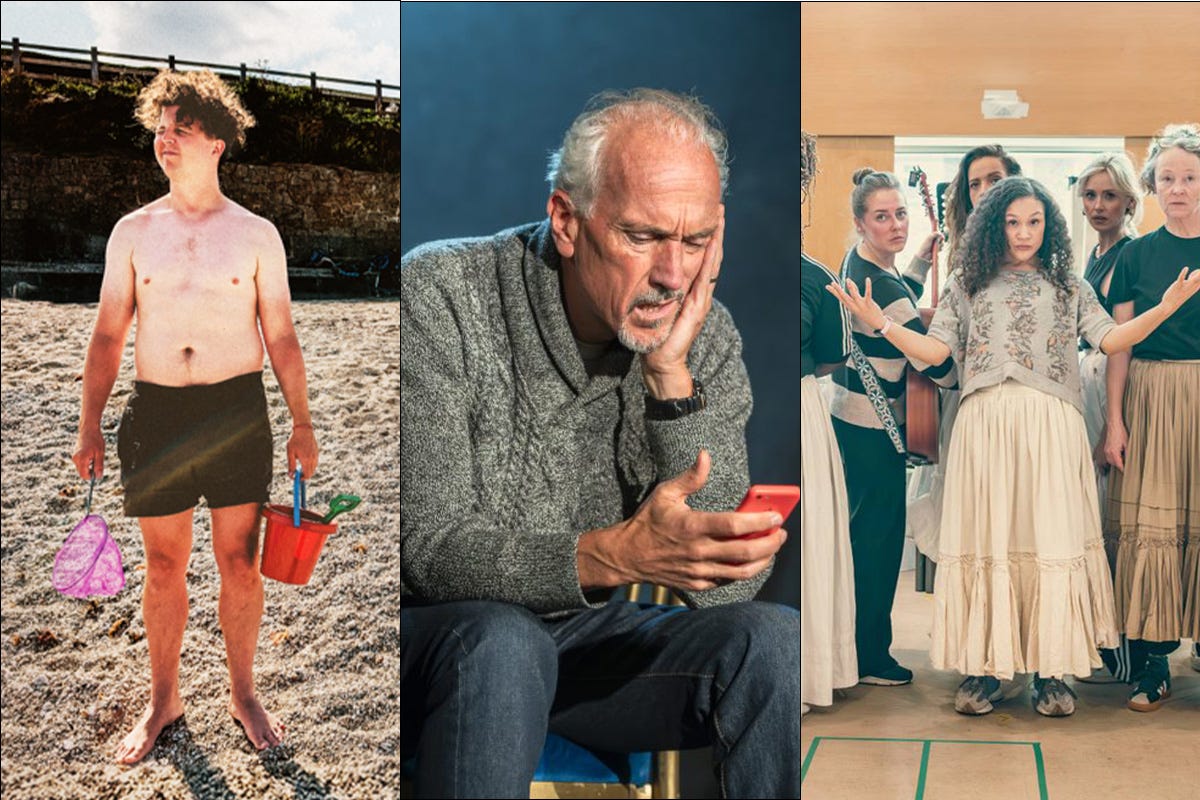
Three shows to see next week
Old Fat F**k Up - Riverside Studios, until December 20
Olly Hawes is the theatremaker that created F**king Legend, the disturbing storytelling show about an ironic man behaving badly on a stag-do with an exhilarating, apocalyptic coda attached. His new show, Old Fat F**k Up tackles middle-aged despair and the damage it does, and has a bunch of dates lined up at Riverside Studios. You can read my interview with Hawes here and get tickets via the button below.

Death Of An Influencer - A Play, A Pie and A Pint, until November 15
Matt Anderson’s debut play - the smartly constructed, emotionally intelligent relationship two-hander Shotgunned - was my favourite show of the 2024 Edinburgh Fringe. Now, the Scottish playwright is back with Death Of An Influencer, a comedy drama about an aging actor and his influencer son. Produced by A Play, A Pie and A Pint, it runs in Glasgow next week, then transfers to The Lemon Tree in Aberdeen. You can read my interview with Anderson here and get tickets via the button below.

Coven - Kiln Theatre, until January 17
This new musical from actor-writer Rebecca Brewer, Grammy-winning folk musician Daisy Chute and Olivier-winning director Miranda Cromwell traces the real story of the Pendle Witch Trials, which took place in Lancashire in the early seventeenth century. You can read my interview with star Gabrielle Brooks in The Stage here and get tickets for its run at Kiln Theatre - already extended - via the button below.
Thanks for reading and supporting The Crush Bar
Thanks to all 4865 subscribers, to all 142 paid supporters, and particularly to The Crush Bar’s champion supporters, whose contributions make all this possible.
The Royal Court Theatre, Francesca Moody Productions, Raw Material Arts, Jermyn Street Theatre; Hampstead Theatre; Storytelling PR; Premier Scotland; Ellie Keel Productions; The Women’s Prize For Playwriting
Your organisation can become a champion supporter of The Crush Bar, join that list, and help keep its independent coverage of theatre going via the button below.
That is it for this week. If you want to get in touch about anything raised in this issue - or anything at all - just reply to this newsletter. I’ll be back on 11 November.
Fergus
I'm new to Substack and am so pleased to have just found you. I really enjoyed this piece - lovely interview.