
Hello, and welcome to Shouts and Murmurs, a weekly round-up of theatre news, reviews, interviews and more from The Crush Bar, written by Fergus Morgan.
If you are a free subscriber, you can usually only read the top bit and, to access the below the paywall, you have to become a paid supporter of The Crush Bar. This week, though, I have removed the paywall so you can see what you are missing.
Organisations can also become champion supporters of The Crush Bar - and get full access, plus the option of having your name on this dedicated tab on The Crush Bar’s Substack page and in the footer of every Friday issue! - via the button below.
Previously in The Crush Bar:

In August, the world of arts criticism experienced one of its periodic spasms of existential despair.
It was prompted by a series of sackings and shuffles at American publications: film reviewers leaving at The Chicago Tribune, Vanity Fair and The Washington Post, and four critics at The New York Times being reassigned. In The Guardian, Jesse Hassenger pondered “the death of the review.” New York Magazine’s Charlotte Klein asked: “Do media organisations even want cultural criticism?” And The New Yorker’s Richard Brody wrote an impassioned “Defense Of The Traditional Review.”
The angst follows a familiar argument. Traditional media outlets are in trouble and need to maximise traffic. Traditional reviews just do not achieve that in the same way that other, shinier, swipe-ier content does. And, now organisations are acutely aware of what stuff is getting views and what isn’t, they have criticism in the crosshairs. Or, as an anonymous critic quoted by Klein puts it, “Now we know people love Q&As and Thanksgiving recipes and could give less of a shit about dance reviews.”
I didn’t really pay attention to it at the time because I was busy, um, being a critic at the Edinburgh Fringe. The discourse was reignited last week, though, by this piece by Spencer Kornhaber in The Atlantic, which argues that traditional criticism is being replaced by “a new class of self-styled critics” on social media. He speaks to a YouTube “Swiftologist”, a Letterboxd film reviewer, a TikTok music critic, and more.
"The definition of the profession is in flux. The credibility of traditional reviewers came from expertise, experience, and the imprimatur of trusted publications. Today, more and more critics pay their own bills, build their own followings, and invent their own rules… For better and for worse, the adage “Everyone’s a critic” no longer seems like an exaggeration.”
Kornhaber’s piece does not sneer at this new criticism, but it is generally pessimistic. Doing it intelligently, morally and sustainably simultaneously is challenging. Either you dumb down to game the algorithm, or you do grubby deals with promoters, or you don’t make much money at all. Oh, and Substack, he writes, is full of “lots of unedited disquisitions seemingly written during caffeine benders.” How dare he.
Anyway, as is ever my wont, I am inclined to ask: where does theatre sit in all of this? Kornhaber’s piece does not mention theatre, but, fortunately, this is one area I do feel qualified to comment on, as someone who writes about theatre online, dumbs it down to game the algorithm, does grubby deals, yet still doesn’t make much money at all.
The thing is, you see, the equation for theatre is different to the equation for other artforms. Theatre - anywhere but Broadway, unless it is directed by Jamie Lloyd, or has Jodie Comer or Sam Heughan in it - does not have anywhere near the same popular appeal or accessibility as film, television or music, so any online commentary of it struggles to generate the interest required to make it sustainable. That is why the most successful theatre YouTubers’ videos get tens of thousands of views max, whereas their film equivalents’ output gets millions regularly. That is why there is no theatre tab on Substack. That is why I am constantly asking you and your organisation for money. What can I say? I have always depended on the kindness of strangers.
Increasingly, I think that if we want theatre criticism to survive - don’t you?! - then we have to accept that theatre is a niche interest, forget about competing for attention in the algorithm-governed wild west of social media, and build a new model together, one that relies on investment, both metaphorical and actual, from the industry itself. Of course, there will be awkward ethics to iron out, but I am optimistic a future can be found. I have spent the last five years ironing right here in The Crush Bar, after all.
To that end, on Friday, I am going to be at the State Of The Nation conference at the Citizens Theatre in Glasgow, speaking in a discussion about how the industry and the media can support one another. Maybe - if Joyce McMillan and Mark Brown let me get a word in edgeways! - we will get on to some of this thrillingly interesting stuff.
In other news: Talawa co-founder Yvonne Brewster died at 87; Cats will be staged in Regents’ Park; Coventry’s Theatre Absolute is closing, as is Bristol’s MAYK; Giant’s Mark Rosenblatt has backed a new programme for Jewish writers; the Bridge Theatre has launched a podcast; Paapa Essiedu isand Caryl Churchill are among those calling for the RSC to cut ties with fashion label Alice + Olivia over its ties to the IDF; The Producers has extended; Inter Alia will transfer to the West End; ACE will invest £42m via its Creative People and Places programme; Playwright José Socrates Delos Reyes has won the Woven Voices Prize; Broadway actors have reached a deal.
Review round-up: Bog Witch, The Seagull, Ragdoll, Safe Space, and more…
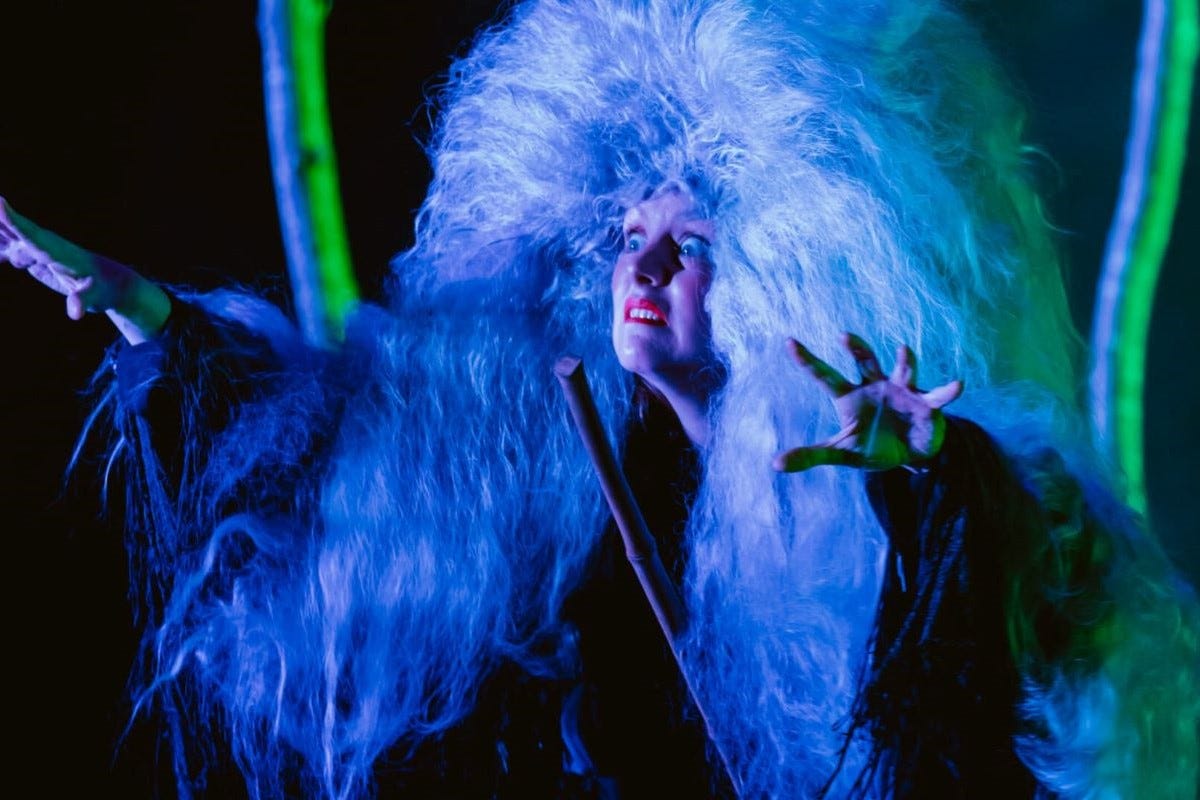
Bryony Kimmings returned with her first solo show in seven years last week. Bog Witch, which runs at Soho Theatre Walthamstow until Saturday, sees the much-loved performance artist recount her odyssean experiences moving to an extreme eco-farm in East Sussex. Co-created with Francesca Murray-Fuentes, the show involves Kimmings amusingly describing the oddities and eccentricities of countryside living and uncomfortably exploring the climate crisis, all with her typical blend of matey storytelling, funny songs, and wacky staging devices. For some critics, it is a bit too messy and bloated, and gets three stars. For others, it is entertaining and insightful, and a total treat to have Kimmings back on stage, and gets four stars.
“Season through season, Kimmings recounts a year of upheaval after moving to a regenerative permaculture homestead with her son, her partner and his daughter. It’s the tale of a town mouse nervously twitching in her new wilderness, cut off from Deliveroo and Selfridges… English folk traditions of music, dance, craft and horror are all interwoven in the staging and the story, which also has a Watch With Mother-style narration about the progress of “poor Bryony” and tempestuous diversions into The Wizard of Oz and The Wicker Man territory.”
Here in Edinburgh, James Brining’s tenure as artistic director of the Lyceum Theatre got underway with a traditional take on The Seagull, in a new translation by Mike Poulton, starring Caroline Quentin as Arkadina. The Herald’s Neil Cooper gives it five stars, admiring how it “stays true to the play’s sense of serious fun without ever losing its yearning heart.” The Guardian’s Mark Fisher gave it four stars due Quentin’s “funny, bold performance” and some “sharp characterisation” around her. The Scotsman’s Joyce McMillan also awards four stars, admiring Poulton’s vibrant, witty and speakable” new version. I, however, found it a “reassuringly decent” but “hardly thrilling” opening statement for Brining’s regime, and I was particularly peeved by Poulton’s crotchety programme essay, in which he dismissed experimental interpretations of Chekhov as “pointless and fatuous.” Still, it looked really nice.
“For him, “mumbling into microphones, mobile phones, flashing neon signs, swigging cans of lager and slurred diction are death to the clarity classic plays deserve”. Each to their own, of course, but resolutely recreating 19th-century Russia yet again is surely another form of fatality.”
Back in London, at Jermyn Street Theatre, Katherine Moar’s second play Ragdoll offers a tense re-examination of the sensational case of Patty Hearst: you can read my interview with Moar here. At Kingston’s Rose Theatre, director Tanuja Amarasuriya has delivered an oddly artificial revival of Private Lives. At Chichester Festival Theatre, Jamie Bogyo’s debut play Safe Space is an entertaining and ambitious but tonally uncertain campus comedy about Yale University’s controversial Calhoun College. At Newbury’s Watermill Theatre, Rob Madge has delivered a sparklingly extravagant adaptation of Brandon Thomas’ Victorian farce Charley’s Aunt, a la Max Webster’s National Theatre revival of The Importance Of Being Earnest. In Manchester, an unimaginative revival of The Kinks jukebox musical Sunny Afternoon kicks off a national tour. And, lastly, Natasha Tripney has Dublin Theatre Festival covered here…

Next week: The Unbelievers at the Royal Court, Macbeth in Stratford.
The week in interviews: Sam Heughan, Jack Holden, Emily Vaughan-Barrett, Munya Chawawa, and more…
“I would love to take this production of Macbeth to the Citizens Theatre in Glasgow” Scottish actor Sam Heughan featured in my weekly interview slot in The Stage, ahead of playing Macbeth with the Royal Shakespeare Company. Anything that mentions Heughan gets a ridiculous number of hits, so this small bit is now one of my most-read interviews ever. I guess we could call that the Outlander effect.
“I have this immovable, unshakeable feeling that I want to run a theatre.” Ahead of his adaptation of Alan Hollinghurst’s Booker Prize-winner The Line Of Beauty opening at the Almeida and the London return of Kenrex, the remarkably prolific Jack Holden has spoken to Susie Mesure in The Financial Times.
“If we were going to use a musical just to rehash something that’s already been done, I don’t think any of us would have been interested – and it wouldn’t be good.” Playwright Jessica Swale and McFly’s Tom Fletcher are putting together the Paddington musical. They spoke to Helen Coffey in The Independent. I’ll just leave this here…

“Just ask people in advance: ‘Is there anything we can do to support you?’” There has been a lot of discussion about the recent survey that revealed the lack of support for women around health issues in the theatre industry. Emily Vaughan-Barratt, the producer behind it, spoke to Sarah Crompton on the WhatsOnStage podcast…
“These boys, the way that they order food is ungodly.” Comedian Munya Chawawa, founder of the Black Boys Theatre Club, which takes young lads to the theatre then gives them a chance to discuss the show over a Nandos, has spoken to The Times’ Emily Prescott, and sent a voicenote to The London Theatre Review…
Further reading: the history of Othello, the climate crisis on stage, the best theatre podcasts, and more…
“72 different Black actors have played Othello in 93 different productions [since 1930]. By contrast, six different Black actors have played King Lear across seven productions.” Ahead of David Harewood taking on Othello for the third time in the West End, JN Benjamin has dived into the knotty history of the role in The Guardian.
“These modern iterations convey their stories laden with humor, wit and finely painted characterization, as well as doom.” Also in The Guardian, environment reporter Oliver Milman wonders theatremakers have finally found a way to engage audiences with climate change, noting the success of Weather Girl and Kyoto. See also: Jack Godfrey and Ellie Coote’s Hot Mess, now running in London.

“Anyone helping audiences find their next favourite show deserves a big thumbs up.” WhatsOnStage’s Alex Wood has put together a list of theatre podcasts worth listening to, and kindly included A Sense Of Direction, the one I produced quarterly for Stage Directors UK, a new episode of which is landing this week.
“I fear we are sleepwalking into disaster, where we will start to lose something that is so ingrained in British culture.” Thursday’s issue of The Stage was its annual “How To Choose Your Drama School” special. The big feature was a long-read by Theo Bosanquet on how conservatoires are adapting to the myriad pressures they face.
"If theatre is ever going to be the open, accessible, intersectional paradise we all want it to be, then we’ve got to get rid of the blazers and bow-ties… Wear a football shirt and trackies, or a t-shirt and shorts.” I wrote those words for an Exeunt piece collating critics’ theatrical bug bears back in 2018. It was revisited on Friday…

That’s all for this issue. Thanks for reading and for supporting this newsletter. I’ll be back in your inboxes on Friday.
If you want to get in touch with me about anything at all, just reply to this newsletter.
Fergus
Painfully apposite piece (and sadly has been for a while). To be honest I didn't need to read it. I knew what it would say as I'm going through the same process myself on a daily basis - simply replace the word Theatre with the word Comedy.
We all have to cut deals of varying grubbiness just to survive these days. Amid all the criticism of comedians who didn't need the money performing in Saudi Arabia recently I did wonder what I would have done if I'd been invited out to cover the Riyadh Festival – no critical strings attached – and offered enough money to bankroll beyondthejoke.co.uk for a couple of years. I think the answer would have been a no, but I honestly don't know.